



Preparing Your Truck for the Tennessee Walking Horse National Celebration
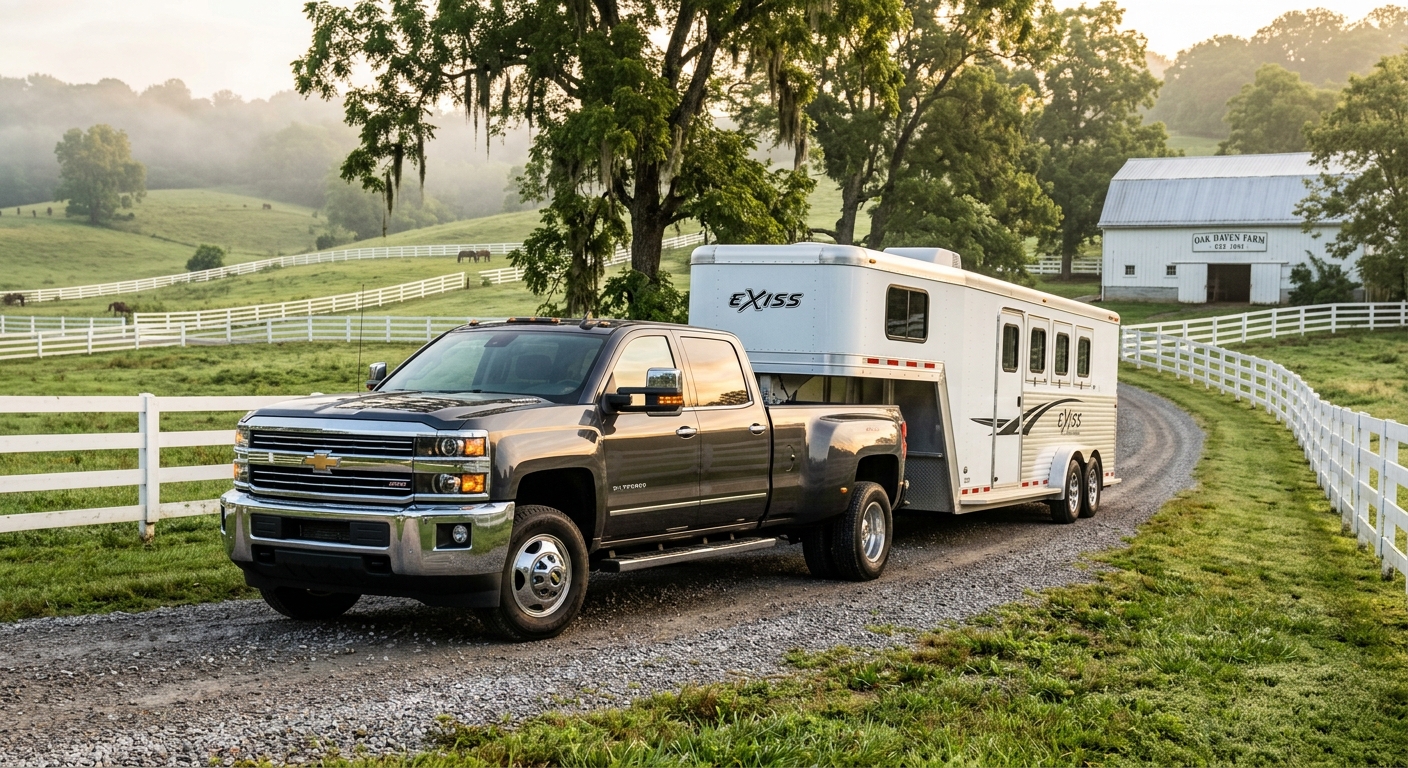
Many agricultural families hauling from the historic farms around Cornersville find that a thorough pre-trip check prevents major mechanical headaches on the highway. We always recommend starting with a complete fluid analysis, paying close attention to your transmission fluid and engine coolant, as towing in warm weather climbs can quickly spike temperatures. If you need assistance getting your vehicle ready, you can visit our Shelbyville showroom for a professional multi-point inspection. For those looking to upgrade their towing setup entirely, exploring our pre-owned vehicle specials is a great way to find a highly capable truck that fits your budget.
Bumper Pull vs Gooseneck: Navigating Tight Showground Spaces
Maneuvering a loaded horse trailer through a crowded, bustling arena parking lot tests both your patience and your equipment. When horse owners visit our service department to prep for show season, they most often ask which trailer type is easier to back up in tight showground spaces before they even ask about towing capacity. The answer depends heavily on how the trailer pivots and how quickly it responds to your steering inputs.
A bumper pull trailer connects to a hitch receiver at the rear bumper of your vehicle, which places the pivot point behind the rear axle. Because of this rearward pivot point, bumper pull trailers respond much faster to steering inputs when backing up, making them highly maneuverable in short, direct distances. However, because they react so quickly, they are also much easier to over-steer and jackknife if you are not careful. While compact SUVs like those in our new Chevrolet Trailblazer inventory are excellent for daily driving, they are not designed for horse trailers; instead, a full-size SUV like the ones found in our new GMC Yukon models is the minimum requirement for safely pulling a light, two-horse bumper pull trailer.
In contrast, a gooseneck trailer connects to a ball hitch located inside the truck bed, directly over or slightly ahead of the rear axle. This configuration causes the trailer to react more slowly to steering inputs when backing up, which actually makes it much easier to make fine, controlled adjustments without the trailer whipping out of line. Furthermore, gooseneck trailers allow for much sharper articulation angles—often up to 90 degrees. This extreme turning capability allows you to pivot the trailer almost completely sideways relative to the truck, making it much easier to squeeze into tight, parallel parking slots at the showgrounds. To handle the physical tongue weight of a gooseneck, you will need a capable pickup truck, such as the options available in our new Chevrolet Silverado 1500 models.
Table of Contents
- Matching Your Truck to Your Trailer: Payload and Towing Capacity Demands
- Managing Tongue Weight and Payload for a Balanced Ride
- Tennessee DOT Safety Regulations and Pre-Trip Inspection Checklists
- Pre-Show Maintenance and Towing Support
Matching Your Truck to Your Trailer: Payload and Towing Capacity Demands
Selecting the right tow vehicle requires matching the physical weight of your trailer and livestock to your truck’s certified capacities. For families living in the growing residential neighborhoods of Spring Hill, finding a truck that balances daily suburban driving with weekend hauling capability is a top priority. It is critical to look at both the towing capacity and the payload capacity of your vehicle, as horse trailers carry exceptionally high tongue weights that count directly against your payload.
For the 2026 Chevrolet Silverado 1500 and the 2026 GMC Sierra 1500, the maximum towing capacity is approximately 13,300 pounds when properly equipped with the available 3.0L Duramax Turbo-Diesel engine and the Max Trailering Package. This capacity is more than enough to safely pull a standard two-horse or three-horse bumper pull trailer, or even a lightweight gooseneck trailer. If you are towing exceptionally large multi-horse trailers with living quarters, however, you will need to step up to heavy-duty capability by exploring our new Chevrolet Silverado HD models to ensure you do not exceed the truck’s rear axle weight ratings.
On the other hand, smaller trucks and SUVs have much stricter limits. For example, the 2026 Chevrolet Colorado midsize pickup offers a maximum towing capacity of approximately 7,700 pounds when equipped with its 2.7L engine and 8-speed automatic transmission, yielding fuel economy of roughly 19 mpg city / 24 hwy in its rear-wheel drive configuration. While this is respectable for a midsize truck, it is only suitable for small, lightweight two-horse bumper pull trailers and should never be used to tow a gooseneck. For those who prefer an SUV but still need strong towing power, browsing our new GMC Yukon XL models provides excellent passenger space and robust towing capacities, whereas compact options like our new GMC Terrain models should be reserved strictly for light utility trailers.
Managing Tongue Weight and Payload for a Balanced Ride
Understanding how weight is distributed across your hitch is just as vital as knowing your overall towing capacity. Tongue weight is the downward force exerted by the trailer coupler onto the hitch ball, and it must be maintained at about 10–15% of the total loaded trailer weight. If the tongue weight is too low, the trailer will suffer from dangerous high-speed sway; if it is too high, it will overload the rear suspension of your truck, lifting weight off the front tires and severely compromising your steering and braking control.
When calculating your truck’s available payload, you must subtract the tongue weight of the trailer, the weight of all passengers, and any gear loaded into the truck bed or cabin. While a light-duty vehicle like those in our new Chevrolet Trax inventory is perfect for fuel-efficient commuting, hauling horses requires a vehicle with a substantial payload rating. Many horse owners choose the spacious cabin and stout frame of our new Chevrolet Tahoe inventory for smaller bumper-pull trailers because it handles tongue weight comfortably while keeping gear secure inside. For commercial-scale operations hauling multiple horses, we recommend checking out our heavy-duty commercial options, including our new Chevrolet Silverado 6500 HD inventory, which provides the massive payload capacity required for heavy gooseneck pins.
To help you visualize how these capacities differ across various vehicle classes, consider the typical capabilities outlined below:
| Vehicle Class | Typical Towing Capacity | Suitable Trailer Types | Key Configuration Focus |
|---|---|---|---|
| Midsize Truck (e.g., Colorado) | Up to 7,700 pounds | Light 2-Horse Bumper Pull | Requires weight-distribution hitch |
| Full-Size SUV (e.g., Tahoe/Yukon) | Up to 8,400 pounds | Standard 2-Horse Bumper Pull | Monitor rear-axle payload limits |
| Half-Ton Truck (e.g., Silverado 1500) | Up to 13,300 pounds | 2 to 3-Horse Bumper or Light Gooseneck | Best with Max Trailering Package |
| Heavy-Duty Truck (e.g., Silverado 2500/3500 HD) | Over 20,000 pounds | Multi-Horse Gooseneck with Living Quarters | Essential for high pin weights |
Tennessee DOT Safety Regulations and Pre-Trip Inspection Checklists
Compliance with state transportation laws is not just about avoiding fines; it ensures your horses arrive safely at the show grounds. Tennessee state law mandates that any trailer with a gross loaded weight over approximately 3,000–3,500 pounds must be equipped with functioning electric or surge brakes acting on all wheels. Additionally, you are legally required to use safety chains or cables that connect the trailer frame to the tow vehicle, and the trailer must have a functioning breakaway system that automatically applies the trailer brakes if it becomes uncoupled.
Before you set out, verify that your trailer does not exceed the maximum legal width of 8 feet, 6 inches on Tennessee public roads. If you are towing a private, non-commercial horse trailer, you generally do not need a Commercial Driver’s License (CDL) as long as your combined gross vehicle weight rating remains under 26,001 pounds. For families who want a highly capable tow vehicle that also serves as a premium family hauler, browsing our new Chevrolet Suburban models or checking out our new Chevrolet Traverse models provides excellent choices for medium-duty towing. For heavy-duty operations that approach the CDL weight limits, our commercial truck specialists can guide you through the specs of our new Chevrolet Silverado 5500 HD inventory.
A comprehensive pre-trip checklist should always include the following steps:
- Inspect all tires on both the truck and trailer for proper inflation, tread wear, and dry rot.
- Test all trailer lights, including turn signals, brake lights, and running lights, to ensure clear visibility.
- Verify that the trailer brakes are engaging correctly using the in-cab brake controller.
- Confirm that the breakaway battery is fully charged and the breakaway cable is securely attached to the truck frame.
- Double-check the hitch connection, safety chains, and coupler locking pin before moving.
Pre-Show Maintenance and Towing Support
A final mechanical check-up before show week provides peace of mind when hauling precious cargo. Our factory-trained technicians can inspect your truck’s brake pads, rotors, suspension bushings, and cooling systems to make sure they are ready for the heavy demands of towing. If you need to schedule a pre-show service appointment or discuss upgrading your towing accessories, please give our team a call at (931) 536-3120. Beyond our commitment to keeping local drivers safe on the road, our dealership is proud to be an active part of the community, including supporting breast cancer awareness and other local initiatives throughout the year.
Modern GM trucks offer incredible built-in technologies to make towing easier and safer. Features like the ProGrade Trailering System, Trailer Side Blind Zone Alert, and Rear Trailer View give you an unprecedented level of visibility and control when navigating tight showground spaces. However, if you ever experience an unexpected issue on the road, remember that manufacturer-backed support is always available. You can contact Chevrolet Roadside Assistance: 1-800-243-8872 or GMC Roadside Assistance: 1-800-462-8782 for professional, brand-specific towing support and emergency services. Stop by our dealership today, and let our team help you prepare your rig for a successful trip to the Celebration.
0 comment(s) so far on Preparing Your Truck for the Tennessee Walking Horse National Celebration