Sales:
931-492-9172
Service:
931-264-4012
Open Today Sales: 9 AM-7 PM





Starting at

Starting at
| 510-664 | Horsepower (hp) | 426-563 |
| 10,000 | Max Towing (lbs) | 10,000 |
| 400 | Est. Max Range (mi) | 320 |
With the rise of the electric vehicle, trucks are finally targeted for the next phase of new releases with the 2024 Chevy Silverado EV vs 2022 Ford F-150 Lightning. Where Ford has chosen the route of the familiar for the styling of its EV truck, Chevy is taking a different approach by offering a pickup diverging from the rest of the Silverado lineup. In fact, the underpinnings of the new Silverado EV more closely align with the GMC Hummer EV, which stands to reason in terms of the need for a foundation to house the weight of the batteries that power the truck. Ford has reverted to a ladder frame from its past trucks in order to accommodate the battery packs as well, but this factor is what gives each truck more stability.
While Ford was quick to release the F-150 Lightning, Chevy held its release back until 2023, but the results of the long wait will be worth the time. Buyers will benefit from numerous features being added to the Silverado EV, many of which are revolutionary for trucks of any type. As part of the architecture of the truck, Chevy chose its design around improving the drag coefficient for less wind resistance; this means all Silverado EV models will come standard with a longer driving range than the Lightning, even with the extended range battery equipped. The 2024 Silverado EV will also have more horsepower and torque than the Ford F-150 Lightning, offering more available power to everything a truck is made to do, whether towing, hauling, or off-roading.
Trim levels at this early stage begin with the WT and RST for the 2024 Silverado EV, with several more trims to be added later in the production year for more customized options. Fleet customers will see the first EV trucks from Chevy in the spring of 2023, and then the RST and WT models will be released in the fall of 2023 for retail customers. Ford currently offers four trim levels of the F-150 Lightning, with the Pro at entry-level, followed by the XLT, Lariat, and Platinum trims. All trims in the Lightning lineup except the Platinum will come with the standard battery, which means far less driving range than the Silverado EV. This and many other aspects of the Ford F-150 Lightning pale in comparison to what the Chevy Silverado EV will bring to the table when it hits the market.
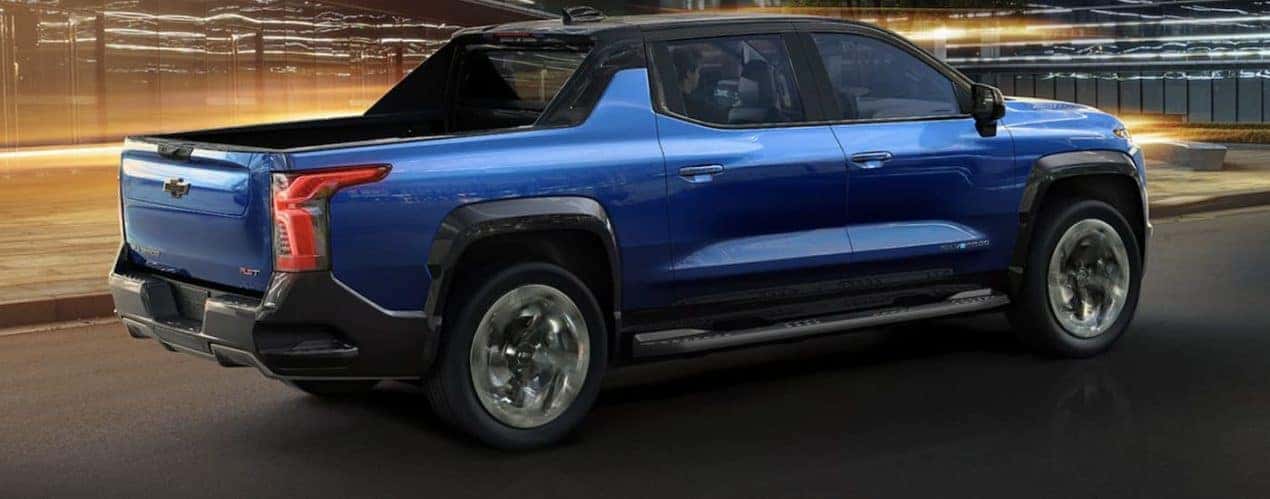
When it comes to performance, electric trucks promise a wide range of potential for capability, particularly for the power available from the operation of the electric motors. Both Chevy and Ford equip their EV trucks with two electric motors to propel the axles, which gives the Silverado EV and Lightning independent suspensions and standard four-wheel drive. Range varies between the two rivals, however, with Chevy estimating up to 400 miles of range at full charge for the Silverado EV compared to Ford’s standard 230 miles of driving range. Only the Platinum trim for the F-150 Lightning will come standard with the extended range of up to 320 miles, which still lags far behind the distance the Silverado EV will be able to travel with its Ultium battery platform at work.
Charging for each of the EV trucks will include the option of home-based rapid charging, which can be installed, as well as utilizing networks for rapid charging while away from home. Chevy’s network of available charging stations nationwide now numbers over 40,000, though Ford only gives access to 19,500 charging stations within its network, and as electric vehicles become more common, that network will make a difference for buyers of EVs.
Capability features for EV trucks differ from traditional gas-powered engines beyond simply the fuel and emissions, as instant power delivered to mobilize even a vehicle as large as a truck means torque delivery is maximized for zero to 60 speeds of about 4.5 seconds for both trucks. The towing capability will be about the same for both trucks at the start of production at 10,000 pounds of towing capacity for the upper trims, though entry-level towing ranges will start at 8,000 pounds for the Silverado EV and 7,700 pounds for the Lightning.
Once production ramps up for the Silverado EV, Chevy promises a WT model that should have up to 20,000 pounds of towing capability, a promise not yet seen from Ford. While both trucks will ride on independent suspension systems, which will vastly improve the ride quality in the cabin as compared with traditional gas-powered trucks, only the Silverado EV promises to have four-wheel steering for an improved turning radius and greater stability at speeds above 50 mph.

Thanks to the fresh opportunities provided by electric vehicles, a number of great options emerge for EV truck buyers. Features like powerful generators and extra storage space are just the beginning of what an EV truck can offer. For instance, both the Silverado EV and F-150 Lightning will have front trunk storage that can be locked and offers weatherproof space for stowing cargo, much like the trunk of a sedan. Unlike a typical car, the front trunk will come with a rubberized load floor that is easy to clean and can add power outlets for plugging in electrical appliances like a coffee pot or crockpot when you need it for camping, tailgating, or working in remote places.
An exciting side effect of owning an EV truck may come in handy during power outages at home, with both the Silverado EV and F-150 Lightning having the capability to provide power for an entire household with the proper equipment. Even with this option, however, the Silverado EV will have more available power with up to 10.2 kW supplied by the PowerBase charging system available, compared to the Lightning at only 9.6 kW total. Powering a home isn’t the only use for the generator, which can supply power for any electrical appliance, and Chevy states the Silverado EV will be able to charge other electric vehicles using this generator as well.
Outlets for these systems will be located in the frunk, cabin, and bed of both trucks, and the bed is where Chevy has gotten innovative with the Silverado EV. A larger bed size of nearly six feet is already an improvement over the 5.5 feet of space in the Lightning, but Chevy takes cargo management further with its MultiFlex Tailgate and MultiFlex Midgate, both of which extend the bed over ten feet when used together. On its own, the Midgate for the Silverado EV allows the rear seats to be folded flat in a 60/40 split, which then extends the bed into the cabin for up to nine feet of cargo space. Using a tonneau cover can make the bed weatherproof and lockable to keep the cabin safe, or the rear window can be removed from the cabin to make the space even larger. Ford doesn’t offer anything more than its work surface tailgate with an available ruler and clamp sites built into the surface.
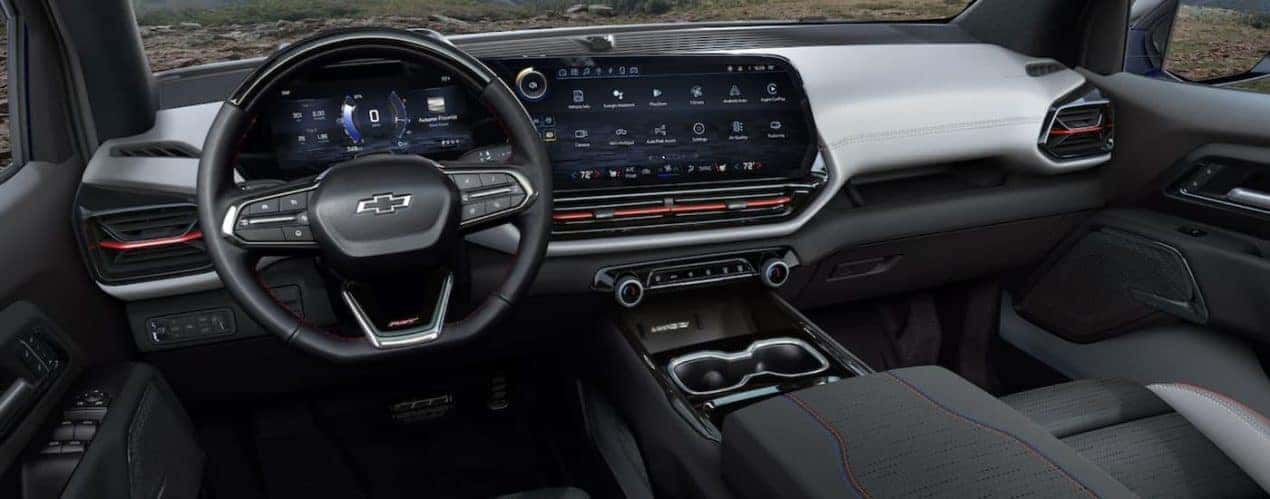
Going electric affords a lot of upgrades in technology that can be incorporated into any vehicle. The 2024 Silverado EV and Ford F-150 Lightning both broaden the horizons of technology for what an electric truck can do. This is more than just larger touchscreens in the center stack—though both trucks offer larger screens than those found in the gas-powered trucks in their lineups—technology in each truck takes its buyer into the future in an instant. Similarities in each truck are found in the over-the-air updates for software, which automatically occurs to keep systems at the leading edge with the most recent innovations. Buyers won’t have to visit a service center to update software, and with cloud-based systems, the settings buyers customize are saved so they can be recovered.
Each truck also learns from the drivers and passengers who interact with the system, which remembers preferred settings for music, navigation, and lighting to automate them for each drive. Chevy has its own Ultifi system to help manage settings and personalizing of the Silverado EV, and as part of the operation of the truck, it can offer up routes for travel that are the best use of the available battery as well as finding charging stations along the way. Ford has its own service for this as well, and each truck has linked the system to an app downloadable to smartphones for remote management. Another aspect of going electric involves semi-autonomous driving capability in Chevy’s SuperCruise and Ford’s Blue Cruise, both of which offer networks of roads that allow for hands-free driving on highways in North America. Chevy has over 200,000 miles of roads included, while Ford only has 130,000 miles, a significant difference.
Inside the cabin, those who purchase an F-150 Lightning will find an interior that is virtually the same as the familiar gas-powered version, while the Chevy Silverado EV took an approach that uses the extra space to its advantage. Without the need for a transmission tunnel, the Silverado EV gives extra space to storage in the center console, a space up to seven gallons that can house much larger items than a traditional Silverado. The back seat of the Silverado EV is gifted with more legroom, so tall adults will have more space in the Crew Cab to be comfortable in any seat. In the RST model, the large 17-inch touchscreen in the center stack blends into the design naturally, where Ford’s 15.5-inch touchscreen resembles a tablet that’s been attached to the dash. Rather than stick to the familiar, Chevy chooses to upgrade the experience to mirror the exceptional opportunity of more space and better tech, so the buyer sees the future before them every time they drive.

Here at Newton Chevrolet GMC, our goal is to find the perfect vehicle for every customer who visits our dealership. Our expertise in navigating the purchase process has been our strength in providing drivers with transportation that is more than just a way to get around; driving should be enjoyable, and everyone deserves to have a vehicle they love. Newton Chevrolet GMC was recognized as the 2021 Dealer of the Year by one of the nation’s most influential sources for dealership excellence, DealerRater. We are honored to have earned this title, and it only fuels our interest in helping every customer with our knowledge in navigating the purchase of a vehicle like the Chevy Silverado EV.
We are ready to help buyers choose options, customize their features, and understand how to utilize the Silverado EV’s strengths and advantages. Financing doesn’t have to be complex, with our expert team standing by to help make sense of rebates and tax breaks involved with the purchase of an EV. We already assist our customers with financing current Chevy EVs, and that familiarity extends into our service center, where our techs are factory trained and certified to handle every aspect of your vehicle’s maintenance needs. Newton Chevrolet GMC is here for you every step of the way, and we welcome your visit to ask us about the 2024 Chevy Silverado EV today.
*Images, fuel economy, and other stats, may reflect higher trim levels, options, or features that may result in a higher cost from the starting MSRP.
MSRP excludes tax, license, registration, additional options, and possible destination charges. Dealers set own prices.