



What is the Towing Capacity for a Chevrolet Truck?
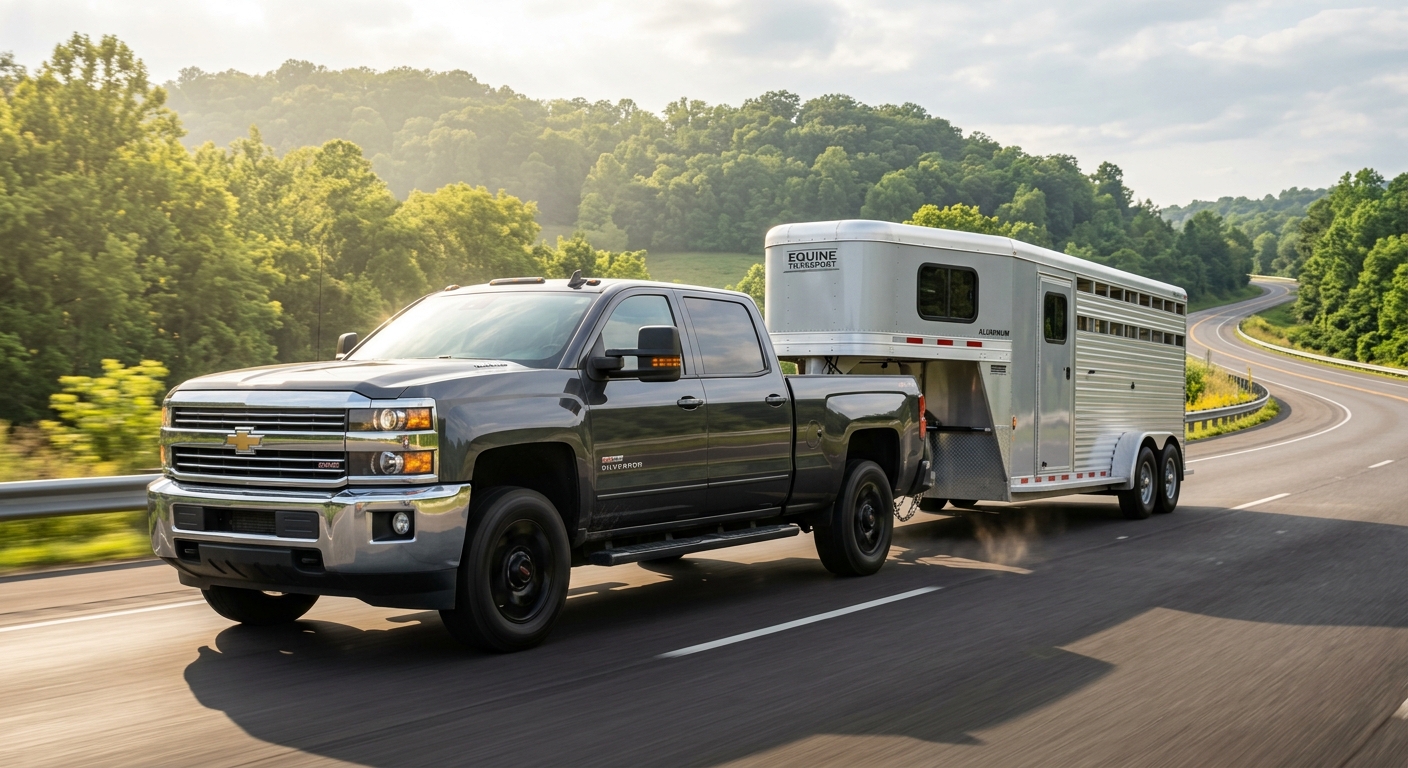
Towing a loaded horse trailer through summer traffic requires substantial engine torque, an integrated electronic trailer brake controller, heavy-duty engine and transmission cooling, trailer sway control, and a truck frame engineered with sufficient payload capacity. A high-torque powertrain—such as a turbo-diesel engine paired with an Allison 10-speed automatic transmission—delivers the pulling force needed to keep live cargo moving smoothly, while factory trailering cameras and high-capacity cooling systems protect both mechanical components and horses during stop-and-go delays in extreme heat. Here’s what Shelbyville-area shoppers should know about Towing Capacity of Chevrolet Trucks.
Middle Tennessee summer humidity places severe stress on tow vehicles. When ambient temperatures climb into the nineties, severe traffic congestion on regional routes causes under-hood temperatures to spike rapidly. Standard cooling systems can quickly reach thermal capacity limits when idling with a heavy load, forcing the engine control module to pull ignition timing or reduce output. GM heavy-duty trucks address this challenge through oversized radiator core volumes, high-output cooling fans, and dedicated auxiliary transmission oil coolers that maintain fluid integrity under continuous heat load.
Engine selection dictates how cleanly a truck manages live weight. The available 3.0L Duramax Turbo-Diesel inline-six in light-duty trucks and the 6.6L Duramax Turbo-Diesel V8 in heavy-duty lineups provide massive low-end torque at low engine RPMs. High torque at low engine speeds allows a truck to accelerate smoothly without sudden downshifts or harsh transmission flares that can cause horses to lose balance in transit.
| FACTORY TRAILERING TECH FOR LIVESTOCK TOWING |
|---|
| • Integrated Electronic Trailer Brake Controller (ABS-linked force control) |
| • Trailer Sway Control & StabiliTrak Dynamic Stability Control |
| • In-Vehicle Trailering App with Pre-Departure Checklists & Profile Memory |
| • Hitch Guidance with Hitch View & Auxiliary Trailer Camera Views |
Maintaining precise control requires continuous communication between the truck and trailer braking systems. Recent GMC and Chevrolet half-ton and heavy-duty trucks feature an integrated electronic trailer brake controller tied directly into the vehicle antilock braking system. The driver information display provides exact trailer gain output, adjusting electric-over-hydraulic or electric trailer brakes proportionally based on foot-pedal pressure rather than relying on delayed pendulum sensors found in aftermarket controllers.
When horse owners visit our showroom before major show events, they usually ask to see the integrated trailer brake interface and trailering camera setup on the test loop before discussing trim levels. Having live camera views inside the horse stall alongside hitch guidance makes maneuvering through crowded staging grounds manageable.
For livestock owners coming from the rolling farmland surrounding Christiana, having a tow rig equipped with factory trailer sway control ensures that sudden crosswinds or shifted animal weight are instantly counteracted by automated, individual wheel braking. To review vehicle setups in person or plan your next haul, stop by our Shelbyville showroom address or give our staff a quick call to discuss available tow packages.
Table of Contents
- What Towing Capacity and Payload Are Required for Horse Trailers?
- How Do Tongue Weight and Gooseneck Dually Setups Keep Livestock Trailers Stable?
- What Tennessee DOT Regulations and Safety Rules Apply to Hauling Horse Trailers?
- Frequently Asked Questions About Horse Trailer Towing in Middle Tennessee
- Get Your Truck Tow-Ready for the Celebration
What Towing Capacity and Payload Are Required for Horse Trailers?
Safely pulling a standard two-horse bumper-pull trailer requires a tow vehicle rated for at least 7,000 to 10,000 pounds of conventional towing, whereas larger three-to-four horse gooseneck trailers with living quarters demand a heavy-duty truck rated between 15,000 and 22,500 pounds of gooseneck towing along with a payload capacity above 3,400 pounds. Choosing the correct configuration requires evaluating both the gross vehicle weight rating of the loaded trailer and the downward hitch force exerted on the truck chassis.
Determining total trailering weight requires adding the dry weight of the trailer, the weight of all horses, packed tack, water tanks, and full fuel tanks. A fully loaded two-horse bumper-pull trailer typically weighs between 6,000 and 8,500 pounds. For this load size, a properly equipped 2026 Chevrolet Silverado 1500 featuring the available 3.0L Duramax Turbo-Diesel, Max Trailering Package, and 2WD Double Cab configuration provides up to 13,300 pounds of maximum conventional towing. However, Chevrolet does not offer a factory fifth-wheel or gooseneck rating for light-duty half-ton trucks; gooseneck hitches require heavy-duty frame structures.
| Chevrolet SILVERADO TOWING & PAYLOAD CAPABILITY OVERVIEW |
|---|
| Silverado 1500 (3.0L Duramax, Max Trailering): |
| • Max Conventional Towing: up to 13,300 lb |
| • Gooseneck/5th-Wheel Rating: Not Factory Rated |
| Silverado 2500HD (6.6L Duramax Turbo-Diesel V8): |
| • Max Conventional Towing: up to 20,000 lb |
| • Max Gooseneck/5th-Wheel Towing: up to 22,500 lb |
| • Payload Range: 3,400 to 4,000 lb |
| Silverado 3500HD Dually (6.6L Duramax V8, Max Trailering): |
| • Max Gooseneck/5th-Wheel Towing: up to 36,000 lb |
When stepping up to a gooseneck trailer or a multi-horse setup with living quarters, payload capacity becomes the primary limiting factor. The tongue weight of a gooseneck setup transfers directly over the rear axle, often placing 2,000 to 3,500 pounds of downward weight into the truck bed. A 2026 Chevrolet Silverado 2500HD equipped with the 6.6L Duramax Turbo-Diesel V8 and Max Trailering Package handles up to 20,000 pounds of conventional towing and up to 22,500 pounds of gooseneck towing, supported by a payload capacity ranging between 3,400 and 4,000 pounds.
For heavy commercial hauling or large four-horse trailers with full living quarters, the 2026 Chevrolet Silverado 3500HD equipped with the 6.6L Duramax Turbo-Diesel V8, dual rear wheels, and the Max Trailering Package achieves a maximum capacity of up to 36,000 pounds of fifth-wheel/gooseneck towing.
Agricultural haulers operating near Lewisburg frequently balance farm transport needs with long-distance show travel. Matching trailer pin weights to manufacturer payload ratings protects rear axle bearings, leaf springs, and tire sidewalls from premature failure. To explore capable tow rigs for your operation, view our new Chevrolet commercial inventory to compare heavy-duty frame configurations.
How Do Tongue Weight and Gooseneck Dually Setups Keep Livestock Trailers Stable?
Trailer stability relies on maintaining proper weight distribution, where conventional bumper-pull hitches require a tongue weight equal to 10 to 15 percent of total loaded trailer weight, while gooseneck hitches transfer downward force forward of the rear axle centerline to eliminate sway. Dual rear-wheel trucks further enhance stability by doubling the rear tire contact patch, providing lateral resistance against wind deflection and shifting live loads.
Live cargo behaves unlike static freight. Horses alter their stance, lean into turns, and move unexpectedly during transit, shifting the trailer center of gravity. When towing a conventional bumper-pull trailer, insufficient tongue weight—anything below 10 percent—causes the trailer coupler to lift on the hitch ball, producing dangerous aerodynamic sway at highway speeds. Conversely, excessive tongue weight overload degrades steering response by lightened front axle contact.
| HITCH CONFIGURATION COMPARISON FOR LIVESTOCK TRAILERS |
|---|
| Conventional Bumper-Pull Hitch: |
| • Recommended Tongue Weight: 10% to 15% of total trailer weight |
| • Attachment Point: Rear frame receiver bumper |
| • Ideal For: 1-2 horse lightweight trailers without living quarters |
| Gooseneck / 5th-Wheel Hitch: |
| • Recommended Pin Weight: 15% to 25% of total trailer weight |
| • Attachment Point: Truck bed ball mount over rear axle centerline |
| • Ideal For: Multi-horse trailers, living quarters, heavy livestock loads |
Gooseneck ball mounts located in the truck bed shift the trailer connection point forward over the rear axle. This mechanical alignment forces trailer tongue weight directly down into the strongest structural portion of the truck frame, turning the tow vehicle and trailer into a unified structure. The forward leverage point prevents the trailer from acting as a lever against the truck rear bumper, virtually eliminating sway caused by passing tractor-trailers or severe side gusts.
Dual rear-wheel trucks, commonly called duallys, add two additional rear tires on a widened axle housing. This wider track width provides immense lateral stability, reducing body roll and preventing tire sidewall flex when hauling tall, wind-resistant horse trailers with high centers of gravity.
Farms along the rolling terrain near Fayetteville benefit significantly from dually axle configurations when navigating unpaved barn drives and sloped pasture entrances. Buyers planning to upgrade their tow vehicle can prepare for show season by applying for financing online through our finance center.
What Tennessee DOT Regulations and Safety Rules Apply to Hauling Horse Trailers?
Tennessee Department of Transportation regulations require every trailer operating with a gross weight of 3,000 pounds or more to feature operational brakes on all wheels, an automatic breakaway switch, approved safety chains, and a total vehicle width not exceeding 8 feet, 6 inches without a special permit to ensure safe operation on public roads. Compliance ensures trailer braking systems activate independently during severe deceleration or accidental uncoupling events.
State law mandates that safety chains or wire cables be crossed underneath the trailer tongue in a cradle pattern before attaching to the truck hitch receiver. This crossed configuration prevents the trailer coupler from dropping onto the road surface if the hitch ball becomes dislodged. The mandatory breakaway switch must connect to an onboard 12-volt trailer battery; in an emergency uncoupling, the pulled pin triggers full battery voltage directly to the electric trailer brakes to bring the runaway trailer to a prompt stop.
| TENNESSEE HIGHWAY TRAILERING SAFETY CHECKLIST |
|---|
| [ ] All-Wheel Brakes: Required on trailers 3,000 lb GVWR and above |
| [ ] Emergency Breakaway System: Operational switch & charged 12V battery |
| [ ] Safety Chains: Crossed underneath coupler to catch tongue if dropped |
| [ ] Width Limit: Maximum 8 feet, 6 inches (102 inches) without oversize permit |
| [ ] CDL Requirement: Not required for non-commercial personal haulers under |
| 26,001 lb Gross Combined Weight Rating (GCWR) |
Private horse owners transporting their own animals to shows, trail rides, or veterinary appointments do not require a Commercial Driver’s License, provided the combined gross vehicle weight rating of the truck and trailer remains under 26,001 pounds and no commercial gain is involved.
Safe driving practices require adjusting operational habits for added weight. Industry safety guidelines recommend extending following distance to at least four seconds when hauling livestock. Stopping distances increase by 20 to 30 percent or more when operating near total weight capacity, making engine braking features like the integrated Duramax auto grade braking system essential for controlling speed on downhill grades. Advanced in-vehicle trailering apps allow drivers to run pre-departure light tests and monitor trailer tire pressures in real time.
Maintaining hardware integrity prevents roadside equipment failures. If you need replacement trailer light harnesses, heavy-duty ball mounts, or brake control modules, consider contacting our parts department for factory-certified trailering accessories.
Frequently Asked Questions About Horse Trailer Towing in Middle Tennessee
Q: Do I need a Commercial Driver’s License to tow my private horse trailer in Tennessee?
A: No, a Commercial Driver’s License is generally not required for personal, non-commercial transportation of horses to shows, events, or trail rides in Tennessee. As long as the combined gross vehicle weight rating of your truck and trailer remains under 26,001 pounds and you are not hauling for commercial fee or prize-money business operations, a standard Class D driver’s license is legally sufficient.
Q: Can a half-ton truck tow a horse trailer with living quarters?
A: Most half-ton trucks lack the payload and rear axle capacity needed to tow a horse trailer with living quarters safely. While a light-duty truck like the Chevrolet Silverado 1500 offers conventional towing ratings up to 13,300 pounds, the heavy pin weight of a living quarters trailer exceeds half-ton payload limits. Living quarters trailers require a heavy-duty three-quarter-ton or one-ton truck.
Q: Why is an integrated electronic trailer brake controller better than an aftermarket unit?
A: An integrated electronic trailer brake controller links directly into the truck antilock braking system and vehicle computer network. Unlike aftermarket inertia units that rely on delayed physical motion sensors, the factory controller reads brake pedal pressure instantly, delivering smooth, proportional electric brake application to the trailer wheels without harsh jerking or delayed stopping response.
Q: What should I check on my truck’s cooling system before towing in summer heat?
A: Prior to towing in high ambient temperatures, inspect engine coolant levels, check radiator and transmission cooler fins for debris or obstruction, and inspect all cooling hoses for soft spots or cracks. Verify that your auxiliary transmission oil cooler is clean and that your engine cooling fan clutch or electric fan engages properly when idling under load.
Q: What trailer documentation or inspection items should I review before driving to a show?
A: Before traveling, confirm that your trailer registration and proof of insurance are up to date in the tow vehicle cab. Perform a physical inspection verifying tire inflation pressure, lug nut torque, emergency breakaway battery charge, safety chain engagement, trailer signal light operation, and floorboard structural integrity beneath rubber stall mats.
Get Your Truck Tow-Ready for the Celebration
Preparing your truck and trailer properly guarantees a safe, stress-free journey to the showgrounds. Ensuring your tow vehicle possesses adequate horsepower, high-capacity cooling systems, proper payload ratings, and certified hitch hardware protects your investment in your horses and equipment. Newton Chevrolet GMC offers a comprehensive lineup of light-duty and heavy-duty trucks equipped with factory trailering technology designed specifically to handle heavy livestock loads in demanding conditions.
Our experienced team understands the technical requirements of livestock transportation, from calculating tongue weights to configuring gooseneck hitches. Whether you need to evaluate your current vehicle tow rating, outfit your truck with factory trailering camera packages, or upgrade to a heavy-duty dually for a large living-quarters trailer, we are here to walk you through every step.
| NEWTON Chevrolet GMC — TOWING SUPPORT SERVICES |
|---|
| • Heavy-Duty Truck Selection (Silverado 1500, 2500HD, 3500HD, Sierra HD) |
| • Factory Trailering & Camera Package Installations |
| • Integrated Trailer Brake Controller Setup & Diagnostics |
| • Vehicle Payload & Towing Capacity Weight Verifications |
Visit our dealership today to test-drive heavy-duty trucks on local routes and inspect integrated trailering features firsthand. Set up your appointment by stopping by our location on North Main Street or by calling our sales experts at (931) 536-3120 to get your vehicle tow-ready.
0 comment(s) so far on What is the Towing Capacity for a Chevrolet Truck?