



Is It More Cost-Effective Long Term to Replace Chevy Brakes and Rotors Together?
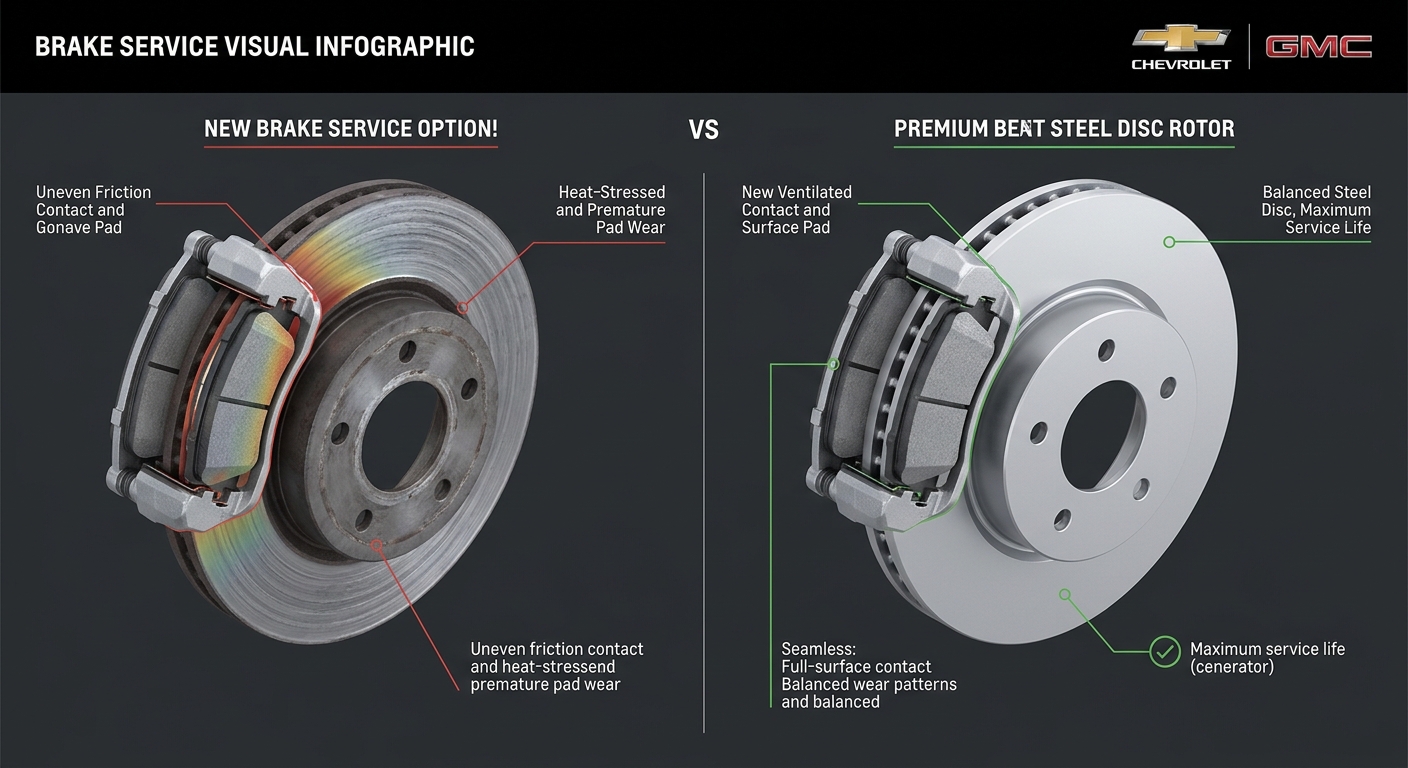
Replacing Chevy brake pads and rotors together is significantly more cost-effective long term because it eliminates duplicate labor fees, guarantees an even friction interface, and prevents accelerated wear on fresh brake pads. Installing new pads over scored or heat-stressed rotors causes early friction material breakdown, leads to brake chatter, and forces a second repair service long before standard maintenance intervals expire. Here’s what Shelbyville-area shoppers should know about Chevy Brakes and Rotors.
| Replacing Pads Only (“Pad-Slap”) | Replacing Pads and Rotors Together |
|---|---|
| Lower initial parts cost | Higher single-visit total |
| Double labor charges over time | Single labor charge for complete assembly |
| Reduced pad lifespan (up to 30% to 50% faster wear) | Maximum friction life and even wear |
| Risk of pedal pulsation, squeal, and uneven drag | Smooth pedal response and quiet stopping power |
When technicians service a braking system, removing the wheel, unbolting the brake caliper, and taking off the caliper bracket accounts for roughly 80 percent of the labor required for the entire job. Replacing only the pads while leaving old rotors in place means paying for that full teardown again when the degraded rotors inevitably fail a few months later. Paying labor charges once for a bundled pad-and-rotor replacement keeps total maintenance expenses substantially lower across a 50,000-mile driving window.
Hardware compatibility plays an equally critical role in long-term savings. Fresh brake pads feature a perfectly flat friction block, whereas used rotors carry microscopic ridges, heat spots, and thickness variations. When a new pad presses against an uneven rotor surface, contact is limited to high spots on the iron casting. This concentrated pressure creates intense thermal hotspots, causes surface glazing, and destroys the new friction material within 10,000 to 15,000 miles.
Drivers hauling farm equipment or heavy cargo along the country routes around Christiana encounter heightened thermal stress on their braking systems. Under heavy bed loads, matching new pads to worn rotors leads to rapid thermal distortion and pedal shudder. Replacing both components simultaneously ensures proper heat distribution across the entire rotor face, protecting the braking assembly from premature failure. To check your braking system or review service options, visit our Shelbyville service center or give our service advisors a quick call today.
Table of Contents
- Is It Okay to Replace Brake Pads Without Changing the Rotors?
- How Do You Know When Your Brake Rotors Need to Be Replaced?
- What Are the Main Causes of Brake Rotor Wear and Failure?
- How Long Do Brake Rotors Typically Last and What Is Minimum Thickness?
- Can You Resurface Rotors Instead of Replacing Them?
- Common Brake and Rotor Replacement Questions Answered
- Keep Your Braking System Operating Safely
Is It Okay to Replace Brake Pads Without Changing the Rotors?
Replacing brake pads without changing rotors is acceptable only when the existing rotors are well above their minimum discard thickness, show zero thermal cracking, and have negligible surface scoring. While skipping rotor replacement saves money on parts during a single shop visit, doing so on worn or uneven discs frequently compromises vehicle safety and stopping performance.
Technicians refer to installing new pads on old rotors without resurfacing as a “pad-slap.” During routine maintenance, a technician must measure the rotor thickness using a precision micrometer and inspect the surface for parallel wear. If the metal measurement exceeds manufacturer safety specs and shows less than 0.002 inches of lateral runout, installing fresh pads alone can serve as an acceptable short-term fix.
However, placing new friction material on aged iron carries distinct performance tradeoffs:
- Extended Stopping Distances: Reduced contact surface area between pad and rotor diminishes immediate braking bite.
- Brake Noise and Vibration: Grooved rotor surfaces scrub against pad edges, causing high-pitched squealing and pedal pulsation.
- Accelerated Pad Degradation: Glazing occurs as localized hot spots overheat small sections of the pad lining.
For commercial operators and work truck owners managing heavy duty vehicles, replacing pads without fresh rotors increases operational risk. Heavy haulers require maximum friction contact to bring severe loads to a controlled stop. You can explore our brake inspection guide to learn how wear patterns affect stopping distance, or browse our new Chevrolet commercial vehicle lineup to see trucks built for heavy-duty towing.
How Do You Know When Your Brake Rotors Need to Be Replaced?
Brake rotors must be replaced when you experience pedal pulsation during high-speed stopping, hear harsh metal-on-metal grinding, or observe surface grooves deeper than 0.060 inches. A raised lip along the outer edge of the rotor disc also signals that the cast iron has worn down past its structural limit.
Pedal vibration remains the most prevalent symptom of bad rotors. As rotors undergo repeated heating and cooling, structural variations in the iron casting cause uneven thickness around the disc face. When the brake caliper squeezes the pads against a rotor with varying thickness, fluid pressure pulses back through the hydraulic lines, causing a distinct shudder in the brake pedal and steering wheel.
A harsh screeching or grinding noise indicates that the friction material on the brake pad has worn away completely, leaving the steel backing plate to scrape directly against the rotor face. This contact gouges deep circular trenches into the iron, ruining the structural integrity of the disc within miles. Modern vehicles come equipped with dashboard pad-wear indicators that alert drivers before friction material drops below 0.25 inches, preventing metal-on-metal destruction.
Physical inspection behind the wheel spokes reveals several visual warning signs:
| Physical Inspection Sign | Underlying Mechanical Issue |
|---|---|
| Deep circular grooves / scoring | Debris entrapment or metal backing plate contact |
| Dark blue or purple discoloration | Extreme overheating / surface glazing |
| Microscopic surface hairline cracks | Severe thermal shock and stress failure |
| Heavy rust flaking on cooling vanes | Environmental oxidation and structural thinning |
Drivers coming in for routine brake service often ask whether replacing pads alone will save money, and our technicians show them the wear lip on their used rotors to explain why fresh pads won’t sit flush. To catch wear before it ruins adjacent components, schedule a professional brake inspection with our team or explore financing options for comprehensive vehicle repairs.
What Are the Main Causes of Brake Rotor Wear and Failure?
Excessive heat buildup, continuous mechanical friction, and environmental corrosion rank among the top reasons brake rotors fail prematurely. Sustained high temperatures alter the crystalline structure of cast iron, creating hard spots that lead to pedal shudder and rapid disc thinning.
Thermal stress represents the single greatest threat to rotor longevity. Squeezing brake pads against a metal disc converts kinetic energy into intense friction heat. When trucks haul continuous trailer loads down the rolling hills surrounding Lewisburg, localized rotor face temperatures can top 1,000 degrees Fahrenheit. If heat cannot dissipate rapidly through the internal cooling vanes, the metal warps, glazes, or develops micro-fissures.
Mechanical friction also wears down metal over time:
- Neglected Friction Pads: Running brake pads past their wear limit forces hardened steel backing plates into the rotor face.
- Caliper Pin Seizure: Sticking caliper slide pins force one side of the pad assembly to drag continuously against the rotor face, wearing down one side of the disc prematurely.
- Debris Entrapment: Road grit and gravel caught between pad and rotor carve deep outer channels into the iron.
Environmental oxidation further accelerates structural deterioration. Vehicles parked outdoors accumulate surface rust overnight as ambient moisture reacts with exposed cast iron. While light surface oxidation rubs off during initial braking stops, prolonged exposure to winter de-icing chemicals corrodes internal cooling vanes. Over time, internal rust flaking weakens the rotor assembly from the inside out.
How Long Do Brake Rotors Typically Last and What Is Minimum Thickness?
Passenger vehicle brake rotors typically last between 30,000 and 70,000 miles, though heavy-duty trucks frequently require replacement between 25,000 and 35,000 miles. A rotor’s exact operational life ends when its physical thickness wears down to the minimum discard thickness stamped directly onto the edge of the casting.
| Vehicle Type & Usage Profile | Typical Rotor Lifespan Range |
|---|---|
| Light Duty Sedans / Crossovers | 50,000 to 70,000 miles |
| Mixed Suburban / City SUVs | 35,000 to 50,000 miles |
| Heavy-Duty Trucks (Towing / Hauling) | 25,000 to 35,000 miles |
Friction pad selection strongly impacts rotor longevity. Soft ceramic brake pads produce minimal dust and wear down rotors slowly, making them ideal for daily commuting. In contrast, heavy-duty semi-metallic brake pads utilize metallic strands to maximize stopping power under load, which wears down the rotor iron at a faster rate.
Technicians determine whether a rotor is safe to remain in service using a specialized micrometer. Measurements are taken at four to eight distinct points around the perimeter of the disc. If any single measurement lands at or below the factory minimum discard thickness, the rotor must be retired. Castings machined below this safety threshold lack the mass required to dissipate heat, leading to rapid brake fade and potential structural cracking during emergency stops.
Can You Resurface Rotors Instead of Replacing Them?
Rotors can be resurfaced—or “turned”—on a specialized brake lathe to eliminate light scoring and lateral runout, provided the remaining metal stays safely above the manufacturer’s minimum discard thickness. If machining would leave the rotor disc too thin to absorb brake heat, complete replacement is mandatory.
Resurfacing uses precision cutting bits to shave off a microscopic layer of cast iron from both sides of the disc face, restoring a flat, smooth surface. Technicians perform this machining using either a bench lathe or an on-car lathe:
- Bench Lathe Machining: The rotor is removed from the vehicle and mounted on a stationary lathe spindle to cut fresh friction surfaces.
- On-Car Lathe Machining: The lathe mounts directly to the wheel hub, truing the rotor to the vehicle’s specific hub bearing to eliminate subtle runout.
While machining was common on older vehicles, modern manufacturing trends have shifted the balance toward replacement. Modern vented rotors are designed with thinner cast walls to trim unsprung weight and boost fuel efficiency. As a result, modern rotors carry very little surplus metal above their discard limit, leaving little room for lathe machining. Because the labor cost to turn a rotor often approaches the price of a brand-new component, installing fresh rotors usually delivers better value and longer performance.
Common Brake and Rotor Replacement Questions Answered
Q: Why do my new brakes squeak right after installation?
Newly installed brake pads and rotors require a brief bedding-in period to transfer an even layer of friction material onto the disc surface. Minor squeaking during the first 100 to 200 miles is common as pads wear flush against the rotor. Persistent screeching, however, indicates missing anti-squeal shims, inadequate high-temperature lubricant on caliper slide pins, or improper pad seating.
Q: What is the difference between ceramic and semi-metallic brake pads?
Ceramic brake pads are made from dense ceramic material blended with copper fibers, producing low dust and quiet operation for daily driving. Semi-metallic brake pads use steel, iron, and copper strands bound in resin. Semi-metallic pads provide superior thermal performance for heavy hauling, but they create more dust and wear down rotors faster than ceramic options.
Q: What does a warped brake rotor feel like while driving?
A warped rotor causes a noticeable pulsing sensation in the brake pedal when slowing down from highway speeds. You may also feel a distinct rhythmic shudder through the steering wheel and seat frame during moderate braking. This vibration becomes more pronounced as heat builds up in the brake system during long downhill descents.
Q: Does stop-and-go traffic wear rotors faster?
Frequent braking in stop-and-go traffic accelerates pad and rotor wear by keeping brake temperatures elevated without allowing airflow to cool the assembly. Constant friction prevents heat dissipation, leading to glazed pads and uneven rotor wear much sooner than steady highway driving.
Q: Will driving with worn rotors damage other brake components?
Driving on severely worn or warped rotors damages surrounding braking hardware over time. Excessive vibration wears out caliper slide pins, degrades rubber piston boots, and causes premature fatigue in wheel bearings. Metal-on-metal grinding also generates heat that can boil brake fluid, leading to a soft, spongy pedal.
If you have questions about choosing pads or rotors, reach out to our parts department for expert advice on OEM replacement options.
Keep Your Braking System Operating Safely
Regular inspections and timely maintenance are essential to keep your braking system functioning safely and effectively. Addressing symptoms like pedal vibration, squealing noises, or extended stopping distances early prevents costly damage to calipers and suspension components while keeping your vehicle operating safely.
Replacing pads and rotors together delivers the best long-term value by eliminating duplicate labor costs and ensuring optimal friction contact. Fresh hardware eliminates brake noise, preserves pedal feel, and restores full stopping confidence for everyday driving and heavy hauling alike.
Our factory-trained technicians inspect brake thickness, measure rotor runout, and install original equipment manufacturer parts engineered specifically for your truck or SUV. If you hear squeaking or feel pedal vibration, schedule a complete brake evaluation with our team today. Stop by visit us in Shelbyville or call (931) 536-3120 to speak directly with our service center. Ask us about Chevy Brakes and Rotors on your next visit.
0 comment(s) so far on Is It More Cost-Effective Long Term to Replace Chevy Brakes and Rotors Together?