



How Often Should Brake Fluid Be Exchanged?
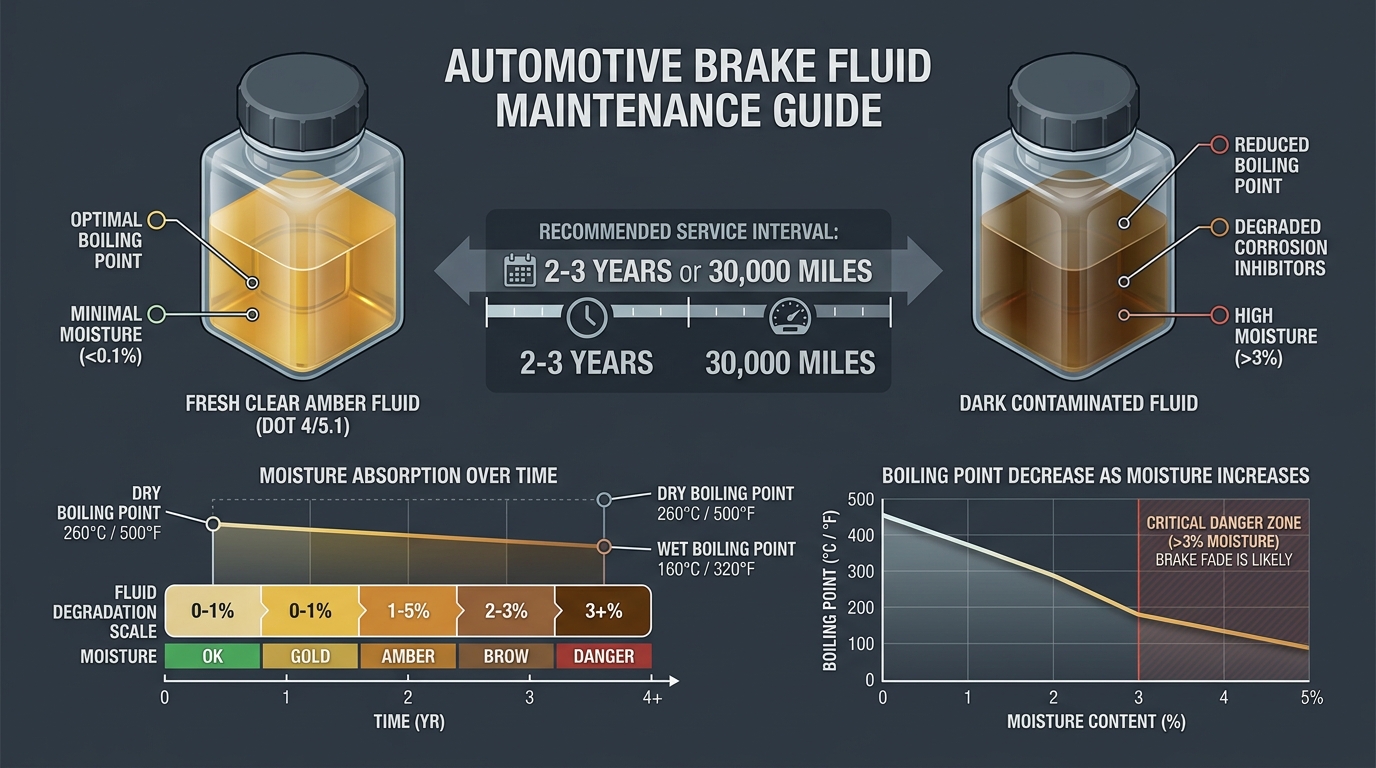
Most automotive manufacturers and technical standards recommend exchanging brake fluid every two to three years or approximately 30,000 miles. Because glycol-based hydraulic brake fluid naturally absorbs humidity through microscopic pores in flexible brake hoses and reservoir seals. Over time, fluid breakdown occurs continuously regardless of whether a vehicle accumulates heavy highway mileage or sits parked in a garage.
Unlike engine oil, which degrades primarily due to mechanical shear, friction, and combustion byproducts, brake fluid deteriorates through moisture absorption. Fresh fluid maintains a high boiling point and non-corrosive chemical balance. As ambient humidity penetrates the sealed hydraulic system over months of regular operation, water content increases. Once moisture levels exceed three percent, the protective additives weaken and the fluid’s thermal tolerance drops drastically, making periodic replacement mandatory for system reliability.
Relying solely on visual appearance can be misleading. While contaminated brake fluid frequently turns dark, cloudy, or tea-colored, fluid that still appears clear can already hold unsafe levels of dissolved moisture. Certified technicians rely on digital boiling-point tools and chemical test strips to evaluate copper corrosion and water saturation accurately. Plan a maintenance inspection by visiting our service center on North Main Street or speaking with our advisors by calling our service department directly.
Table of Contents
- Why Is Brake Fluid Exchange Vital for Vehicle Safety and Corrosion Prevention?
- What Are the Signs of Contaminated Brake Fluid and Why Topping Off Is Not Enough?
- What Is the Boiling Point Difference Between DOT 3 and DOT 4 Brake Fluid?
- How Do OEM Schedules and Vehicle Types Impact Brake Fluid Service Intervals?
- Common Questions About Vehicle Brake Fluid Care and Testing
- How to Ensure Peak Stopping Power with Expert Care
Why Is Brake Fluid Exchange Vital for Vehicle Safety and Corrosion Prevention?
Exchanging brake fluid on schedule prevents hydraulic vapor lock and protects precision ABS components from destructive internal rust. Glycol-based formulations are intentionally designed to be hygroscopic—meaning they attract and hold water—so that pockets of pure water do not pool in low sections of the brake lines and freeze or boil instantly. However, as the total water percentage inside the hydraulic circuit climbs, the fluid’s boiling point decreases, creating severe safety risks under heavy stopping conditions.
When brake pads press against rotors, severe heat transfers directly into the brake calipers and hydraulic fluid. If water-contaminated fluid reaches its reduced boiling threshold during hard braking, the trapped moisture converts into compressible steam bubbles. Because liquid cannot be compressed under foot pressure, hydraulic force transfers instantly to the calipers. Steam, on the other hand, compresses easily under pedal force, resulting in a sudden floor-bound pedal travel known as vapor lock or brake fade.
Hydraulic Fluid Moisture Risks
| Fresh Fluid (Low Moisture) | Contaminated Fluid (High Water) |
|---|---|
| High boiling point under pressure | Reduced boiling threshold |
| Incompressible hydraulic transfer | Vapor lock / compressible steam |
| Active corrosion-inhibitor package | Internal rust on ABS valves |
| Firm, responsive brake pedal feel | Soft, spongy pedal travel |
Beyond pedal performance, moisture reacts chemically with the steel, copper, and aluminum parts inside the braking assembly. Over time, oxidized copper ions and rust scale travel through tiny internal passageways, potentially damaging internal seal surfaces or clogging delicate anti-lock braking system valves. The rolling hills and agricultural transport routes around Christiana generate elevated brake heat during loaded trailer hauling, making clean hydraulic fluid essential for maintaining stopping control. Drivers comparing truck capabilities on our lot often ask if a visual reservoir check is sufficient; our service advisors demonstrate how electronic testers measure true boiling points before pedal fade ever occurs. Business operators evaluating fleet maintenance can explore our inventory of new Chevrolet commercial vehicles, locate a specific work truck using our custom vehicle finder service, or review ownership options by exploring auto financing options.
What Are the Signs of Contaminated Brake Fluid and Why Topping Off Is Not Enough?
Warning signs of degraded brake fluid include a soft or spongy pedal feel, noticeably longer stopping distances, discolored dark fluid in the master cylinder reservoir, or an illuminated ABS dashboard alert. Simply topping off the reservoir with fresh fluid fails to address these issues because it leaves degraded, moisture-laden fluid trapped inside the hydraulic lines, proportioning valves, and wheel calipers.
Topping off merely adjusts the fluid level as brake friction linings wear down naturally. It leaves accumulated water, oxidized metals, and degraded chemical additives circulating throughout the active hydraulic circuits. A complete service requires a full hydraulic system flush, which pressure-purges old fluid out through bleeder valves at all four wheels while introducing fresh fluid into the reservoir.
- Soft or Spongy Pedal: Air or steam bubbles compressing inside hydraulic lines cause the brake pedal to feel mushy rather than firm.
- Dark or Discolored Fluid: Clear or pale amber fluid turns dark brown or black as heat breaks down chemical additives and suspended debris accumulates.
- Burning Odor After Stopping: Heavy braking on contaminated fluid generates extreme heat that emits a distinct, acrid chemical smell.
- ABS Warning Light: Contaminated fluid carrying suspended metallic particles can disrupt delicate speed sensor valves and trigger anti-lock brake system fault codes.
What Is the Boiling Point Difference Between DOT 3 and DOT 4 Brake Fluid?
Federal motor vehicle safety standards mandate that DOT 3 fluid must maintain a minimum dry boiling point of 401°F and a wet boiling point of 284°F, whereas DOT 4 fluid achieves a higher minimum dry boiling point of 446°F and a wet boiling point of 311°F. Dry boiling points measure pure fluid fresh from a sealed container, while wet boiling points reflect fluid that has absorbed approximately 3.7 percent water volume after extended field use.
DOT 3 vs. DOT 4 Boiling Point Specs
| Fluid Standard | Minimum Dry Boiling Point | Minimum Wet Boiling |
|---|---|---|
| DOT 3 | 401°F (205°C) | 284°F (140°C) |
| DOT 4 | 446°F (205°C) | 311°F (155°C) |
Many factory specifications, including genuine GM and ACDelco formulations, call for DOT 3 fluid designed specifically for everyday commuting and light truck duties. DOT 4 formulations incorporate borate ester additives that raise thermal resistance, making them ideal for performance vehicles, heavy towing, or mountain driving where friction temperatures peak rapidly.
While DOT 3 and DOT 4 glycol fluids are chemically compatible and can mix in emergencies, service guidelines mandate maintaining or exceeding the original manufacturer rating. Downgrading a system designed for DOT 4 back to DOT 3 reduces wet boiling performance and increases the risk of early vapor lock under thermal stress.
How Do OEM Schedules and Vehicle Types Impact Brake Fluid Service Intervals?
Brake fluid exchange intervals often depend on factors like vehicle weight and powertrain, yet many manufacturers converge on a two to three year or 30,000-mile recommendation. Heavy-duty trucks, vehicles equipped with high-towing packages, and performance models degrade fluid faster due to intense operating temperatures, making biennial replacement essential.
Electric and hybrid vehicles require routine brake fluid flushes on the same two-to-three-year schedule as conventional gasoline cars. Although electric drive units use regenerative braking to slow the vehicle down, traditional hydraulic calipers step in for emergency stops and final deceleration. Because regenerative systems reduce overall hydraulic use, the fluid experiences fewer hot cycles to drive off trapped condensation, making time-based moisture accumulation a major concern.
Rural commuters making daily trips along farm-to-market corridors near Lewisburg place consistent thermal demands on hydraulic lines during loaded agricultural hauling, making scheduled flushes vital for long-term safety. Maintaining complete vehicle safety also involves finding the right tires for changing road conditions and learning when to inspect your brakes during routine oil changes.
Common Questions About Vehicle Brake Fluid Care and Testing
Q: Can brake fluid moisture content be tested without bleeding the system?
Technicians measure moisture levels using electronic boiling-point testers or chemical test strips dipped directly into the master cylinder reservoir. Digital meters pass a small electrical current through the sample or heat it to identify exact water percentage and boiling thresholds in seconds. If test results show water content nearing three percent, a complete fluid exchange is needed regardless of vehicle mileage.
Q: Does driving in humid or rainy environments speed up fluid breakdown?
High humidity accelerates moisture absorption across flexible rubber brake lines and reservoir cap vents. While the hydraulic circuit operates under high pressure, atmospheric moisture continuously migrates toward the glycol fluid inside. Vehicles parked outdoors or driven through heavy seasonal rainfall absorb water faster than those kept in climate-controlled garages, making strict time-based service intervals critical.
Q: Should brake fluid be replaced whenever new brake pads and rotors are installed?
Replacing brake fluid during a major brake pad and rotor service is highly practical because technicians are already working at all four wheel bleeder valves. Flushing fresh fluid through the calipers ensures that new pads interact with a fully pressurized, contamination-free hydraulic system. Combining these services restores firm pedal response and protects new caliper pistons from internal corrosion caused by old, saturated fluid.
Q: What happens to ABS valves if contaminated fluid stays in the system?
Contaminated fluid carries dissolved copper, iron, and rust scale that settle inside the narrow channels of the anti-lock braking system modulator block. These abrasive particles wear down delicate internal rubber seals and cause miniature solenoid valves to stick open or closed. Replacing a damaged ABS hydraulic assembly is far more costly than performing routine, preventive fluid exchanges on schedule.
Q: How does brake fluid maintenance tie into general wheel and tire care?
Brake inspections occur alongside tire rotations and alignment checks, allowing technicians to inspect lines, calipers, and tread wear simultaneously. Addressing hydraulic health while scheduling a wheel alignment check ensures balanced stopping power, straight tracking under heavy braking, and maximum service life from both friction components and tire rubber.
How to Ensure Peak Stopping Power with Expert Care
Maintaining brake fluid freshness is crucial for hydraulic system integrity, ABS protection, and ensuring reliable pedal feel during emergency stops. Relying on time-based maintenance rather than visual inspection keeps fluid boiling points above safety thresholds and prevents premature component failure.
Our factory-trained service team uses professional fluid flush equipment and genuine ACDelco formulations to keep your vehicle operating at peak factory standards. Get personalized maintenance advice or drop by for an inspection by pulling up directions to our Shelbyville location or reaching out at (931) 536-3120 to reserve your next service appointment.
0 comment(s) so far on How Often Should Brake Fluid Be Exchanged?