



How Do I Know If My Chevy’s A/C Has a Refrigerant Leak?
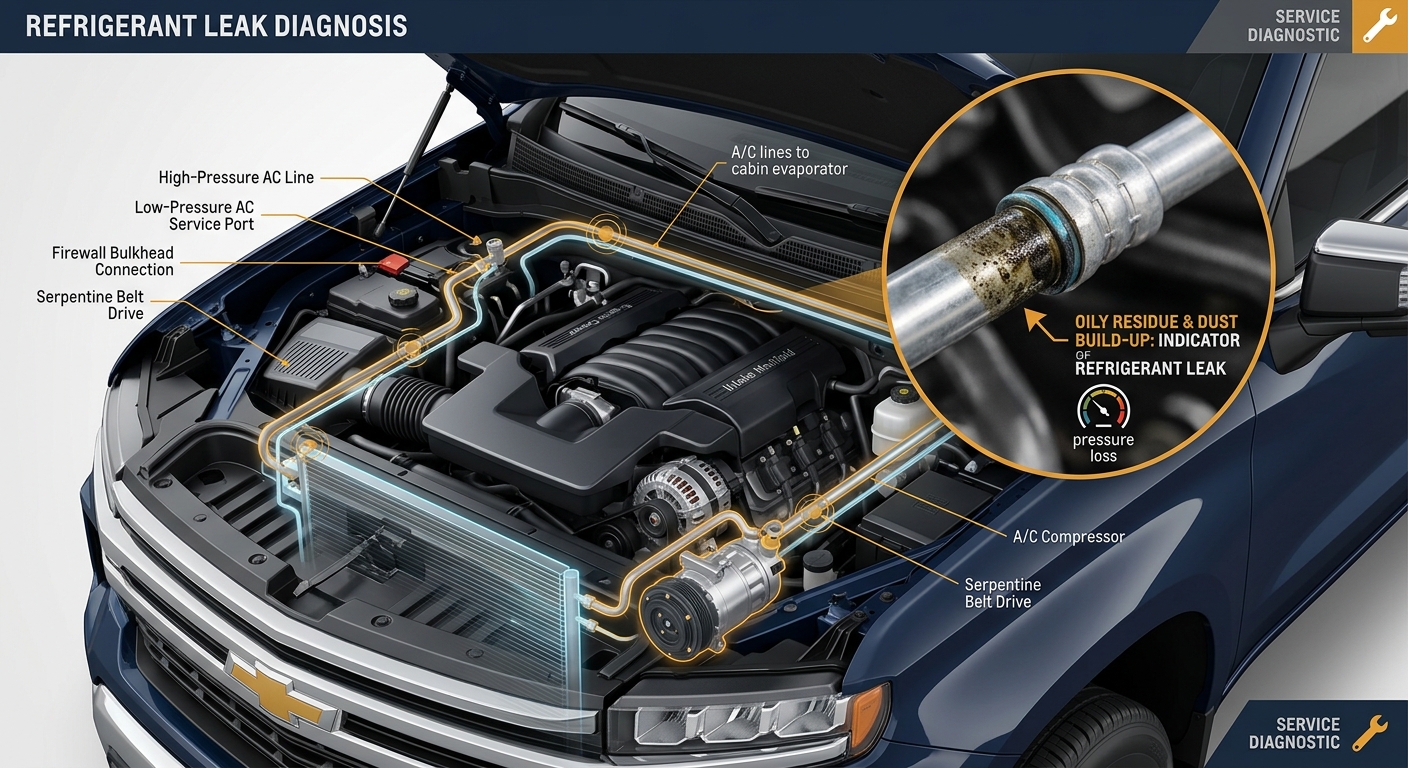
You can identify a refrigerant leak in your Chevrolet or GMC vehicle by warm or lukewarm air coming from the dashboard vents, visible oily residue around HVAC line fittings and compressor joints, or an A/C compressor clutch that cycles rapidly or refuses to engage. Because automotive air conditioning operates in a closed system, any drop in cooling capacity indicates a loss of refrigerant pressure rather than normal consumption.
| Visual & Performance Indicator | Primary Mechanical Cause |
|---|---|
| Vents blowing warm or ambient air | Insufficient refrigerant charge level |
| Dark, oily film on A/C lines/joints | Refrigerant oil escaping at seal or fitting failure |
| Rapid clicking from engine bay | Low-pressure switch cycling compressor clutch |
| Musty smell or weak air velocity | Clogged cabin air filter or evaporator buildup |
Automotive A/C systems rely on a specific ratio of refrigerant and specialized compressor oil circulating under precise pressure. When a leak forms—whether from a hairline crack in the condenser coil, a worn O-ring, or a leaking Schrader valve—refrigerant gas escapes into the atmosphere while escaping lubricant leaves an oily residue. Over time, this dark, sticky residue traps road dust and dirt around the leak site, making visual inspection one of the most reliable ways to spot a breach under the hood.
Inside the cabin, the most immediate signal is a gradual or sudden loss of refrigeration. When system pressure drops below a safe threshold, the low-pressure safety switch disconnects power to the compressor clutch to prevent the pump from running without oil. Drivers often hear the clutch rapidly clicking on and off every few seconds as it attempts to cycle, or it may fail to spin entirely.
Ignoring a minor leak leads to reduced compressor lubrication, potentially causing internal pump seizure and widespread metal debris throughout the HVAC loops. Drivers managing daily agricultural hauls across Christiana during peak summer temperatures rely on efficient air conditioning to maintain cabin safety. If your climate control is blowing warm air, scheduling a professional pressure check or giving our team a quick call at (931) 536-3120 allows certified technicians to dye-test the system and seal leaks before major components suffer damage. For local drivers needing routine maintenance, visiting our Shelbyville service center gets your HVAC system evacuated, leak-checked, and recharged to original factory specifications.
Table of Contents
- What Are the Signs of Engine Cooling and Radiator Issues on a Chevy Silverado?
- How Do You Safely Check and Maintain Engine Coolant Levels?
- How Does GMC Sierra Automatic Climate Control Keep Cabins Cool?
- Why Is the Cabin Air Filter Essential for Summer HVAC Performance?
- Common Questions About Chevy and GMC Summer Cooling Maintenance
- Keep Your Truck Cool This Summer
What Are the Signs of Engine Cooling and Radiator Issues on a Chevy Silverado?
Common symptoms of a failing radiator or engine cooling system on a Chevrolet Silverado include high engine operating temperatures, coolant puddling beneath the front axle, low coolant warnings on the driver information center, discolored fluid sludge in the surge tank, and bent radiator fins. Addressing these warning signs early protects vital engine components from thermal distortion and gasket failure.
| Silverado Cooling System Symptom | Immediate Diagnostic Priority |
|---|---|
| High coolant temperature reading | Check thermostat function and coolant volume |
| Bright green or orange fluid spots | Pressure test radiator core and hose connections |
| Brown, thick sludge in expansion tank | Inspect for internal oil cooler fluid cross-contamination |
| Bent cooling fins across front core | Clean road debris; straighten fins or replace core |
The engine cooling assembly on a full-size pickup operates under elevated pressure and thermal cycles, especially when hauling heavy payloads. A failing radiator often develops hairline stress fractures along its plastic end tanks or aluminum seam seals. When fluid escapes, it pools underneath the front bumper, displaying the distinctive bright orange or red color of fresh factory coolant. If the fluid in the coolant tank appears dark brown or sludgy, it points to internal breakdown or cross-contamination from an integrated transmission oil cooler.
Underneath the hood, the thermostat regulates fluid movement between the engine block and radiator core. If a thermostat becomes stuck closed, coolant remains trapped inside the engine housing, triggering a rapid spike on the temperature gauge and illuminating the dashboard red thermometer light. On older truck models equipped with a mechanical fan clutch, a failing clutch fails to lock up when hot, preventing adequate airflow through the radiator during prolonged idling or slow transit.
Summer towing places extreme demand on cooling hardware, making core cleanliness critical. Road debris, insects, and chaff can clog the external cooling fins, severely restricting airflow across both the radiator and A/C condenser coils. Pickup drivers pulling livestock trailers around Lewisburg often subject their cooling systems to heavy load demands on rural inclines, where an uncleaned radiator rapidly causes thermal spikes. Truck owners considering upgrading their tow vehicle can browse new GMC Sierra 1500 models equipped with heavy-duty cooling packages and high-capacity radiator designs.
How Do You Safely Check and Maintain Engine Coolant Levels?
You can safely check your vehicle’s coolant level by inspecting the translucent coolant recovery reservoir under the hood while the engine is completely cold, verifying that the fluid level sits between the cold full and cold fill markings. Never remove a reservoir pressure cap or radiator cap while the engine is hot, as pressurized steam and boiling liquid can cause severe burns.
Factory specifications for most modern Chevrolet and GMC models call for long-life Dex-Cool engine coolant, engineered for extended service intervals up to 5 years or 150,000 miles under light-duty conditions. However, real-world summer driving, heavy towing, and stop-and-go traffic require regular manual checks. Checking fluid levels once a month or during every engine oil service ensures early detection of slow fluid losses.
| Maintenance Step | Action Required |
|---|---|
| Temperature Check | Verify engine is fully cool to the touch |
| Visual Fluid Inspection | Confirm fluid level sits between MIN and MAX lines |
| Hose & Belt Check | Inspect hoses for bulging, soft spots, or cracks |
| Service Scheduling | Schedule flush every 100,000 to 150,000 miles |
When topping off a low reservoir, always use a pre-mixed 50/50 ratio of approved coolant and distilled water. Using plain tap water introduces minerals that form scale deposits inside narrow engine passages and radiator tubes, reducing heat transfer efficiency over time. If the coolant level drops repeatedly without visible puddles on the ground, a technician should perform a cooling system pressure test to locate internal leaks around intake manifolds or cylinder head gaskets.
Maintaining proper fluid chemistry prevents internal corrosion, water pump cavitation, and premature heater core clogging. Drivers planning comprehensive summer vehicle care can review flexible service financing options to budget for recommended interval fluid flushes alongside routine maintenance.
How Does GMC Sierra Automatic Climate Control Keep Cabins Cool?
The automatic climate control system in a GMC Sierra maintains interior target temperatures by continuously reading data from cabin temperature sensors, exterior ambient air sensors, and dashboard solar radiation sensors to automatically adjust fan speed, blend door positions, and A/C compressor output. This electronic integration delivers rapid pull-down cooling even during extreme outdoor heat.
| Climate Control Component | Functional Purpose |
|---|---|
| Cabin & Solar Sensors | Measure interior ambient temp and direct sun load |
| Variable Displacement Compressor | Adjusts refrigerant output based on cooling demand |
| Dual-Zone Actuators | Independently control driver and passenger temps |
| Evaporator Temperature Sensor | Prevents core freeze-up during continuous output |
When set to AUTO mode, the climate system optimizes cabin cooling without requiring manual adjustments. On high-heat days, the control module automatically engages recirculated air mode to draw cool air from inside the cabin through the evaporator rather than pulling in hot outside air. As cabin air approaches the driver’s pre-set temperature, the system slows the blower fan speed and adjusts the variable-displacement compressor to reduce load on the engine while maintaining humidity control.
In dual-zone configurations, individual blend door actuators adjust independent air channels for the driver and front passenger. If one side of the cabin consistently blows warm air while the other blows cold, a failed blend door actuator or a software calibration issue is often responsible rather than a low refrigerant charge.
For heavy-duty truck owners who haul trailers in demanding summer weather, maintaining optimal HVAC efficiency keeps long highway trips comfortable. Interested drivers can review full 2026 GMC Sierra 1500 details or explore high-capacity 2026 GMC Sierra HD capabilities online. For maintenance or replacement climate components, vehicle owners can reach out to our parts department for factory-direct component availability.
Why Is the Cabin Air Filter Essential for Summer HVAC Performance?
A clean cabin air filter is essential for summer HVAC performance because it prevents dust, pollen, and debris from clogging the blower motor and evaporator core, ensuring maximum airflow velocity through your vehicle’s air vents. A restricted filter drastically chokes system airflow, forcing the A/C system to run longer and harder to cool the cabin interior.
| Clogged Filter Symptom | Impact on HVAC Performance |
|---|---|
| Reduced vent air volume | Restricts air volume passing across evaporator |
| Increased blower motor noise | Causes electric fan motor to strain against mass |
| Musty cabin odors | Traps moisture, promoting mildew growth on core |
| Slow glass defrosting | Reduces moisture-removal capacity during high humidity |
Over months of driving, the filter media collects fine road dust, plant particles, and environmental grime. As these particulates fill the filter pores, air volume drops dramatically. Drivers often notice that setting the fan to its highest speed produces excess noise from under the glove box but yields only a weak trickling air stream from the dashboard vents.
In addition to restricting airflow, a dirty cabin filter can collect ambient moisture during humid summer conditions. Damp organic debris trapped against the filter housing provides an ideal environment for mold and mildew growth, creating a stale, musty odor whenever the air conditioner is turned on. Replacing the filter cleans the incoming air stream and protects sensitive internal HVAC electronics from overheating caused by restricted ventilation.
General service guidelines call for inspecting or replacing the cabin air filter every 22,500 miles, or roughly once a year. Vehicles driven frequently on unpaved gravel roads or in high-pollen agricultural environments may require replacement every 10,000 to 12,000 miles to maintain optimal air volume and cabin purity.
Common Questions About Chevy and GMC Summer Cooling Maintenance
Q: How can I tell if my vehicle’s A/C system is low on refrigerant?
A low refrigerant charge typically presents as lukewarm air coming from the vents, a compressor clutch that continuously clicks on and off in rapid succession, or dark oily residue coating the metal fittings and rubber hoses under the hood. When system pressure drops below operating specifications, safety sensors prevent the compressor from operating continuously to protect internal pump seals from running dry.
Q: Can a failed thermostat cause my engine to overheat immediately?
A thermostat stuck in the closed position blocks fluid circulation to the radiator, causing engine temperatures to spike rapidly within minutes of driving. Because coolant remains trapped within the engine block without passing through the front radiator core for thermal exchange, the driver information center will illuminate a red coolant temperature light to signal emergency thermal conditions.
Q: How often should Dex-Cool engine coolant be replaced in a GMC truck?
Factory maintenance guidelines specify an initial replacement interval of 5 years or 150,000 miles under normal driving conditions. However, severe-service conditions—such as frequent trailering, long engine idling periods, or extreme ambient heat—may require earlier inspections and coolant flushes around 100,000 miles to preserve anti-corrosion additives and prevent internal scale accumulation.
Q: What causes a musty smell when I turn on my air conditioner?
Musty odors are usually caused by mold or mildew spores multiplying on the damp surface of the HVAC evaporator coil or within a saturated cabin air filter. Condensation naturally forms on the cold evaporator surface during summer operation, and if leaves or organic dust settle on the wet core, trapped moisture breeds odor-causing bacterial growth that blows into the passenger space.
Q: Why is my A/C compressor clutch clicking repeatedly under the hood?
Rapid compressor clutch cycling occurs when internal pressure switches detect insufficient refrigerant in the system loop. The control module repeatedly attempts to engage the compressor clutch, but as soon as operating pressure drops below the minimum safe threshold, the low-pressure switch disengages the clutch to protect the pump against oil starvation.
Keep Your Truck Cool This Summer
Proactive summer cooling maintenance prevents unexpected roadside breakdowns, maintains vehicle efficiency, and keeps your cabin comfortable during peak thermal conditions. Addressing low refrigerant levels, checking engine coolant clarity, and inspecting drive belts and cabin filters preserves high-value engine and HVAC hardware for long-term operational reliability.
| Summer Maintenance Checklist | Recommended Service Action |
|---|---|
| A/C Refrigerant Pressure | Perform vacuum test, dye leak trace, and recharge |
| Engine Coolant & Hoses | Check reservoir level, hose firmness, and cap seal |
| Radiator & Condenser Cores | Clear debris, insects, and road mud from fins |
| Cabin Air Filter | Inspect filter media; replace if dusty or clogged |
Whether you require a comprehensive A/C diagnostic test, a complete engine coolant flush, or routine filter replacements, relying on factory-trained service technicians ensures your Chevrolet or GMC operates to original manufacturer standards. Routine inspection of cooling components protects your investment and ensures worry-free summer transit across Middle Tennessee.
To schedule your summer cooling inspection or consult directly with certified service advisors, call our team at (931) 536-3120 today. You can also drop by our dealership address on North Main Street to speak with our service team in person and prepare your vehicle for summer driving. Our team can answer any question about a Refrigerant Leak in your A/C system.
0 comment(s) so far on How Do I Know If My Chevy’s A/C Has a Refrigerant Leak?