



How Can I Find the Best Used Truck Dealer Near Me?
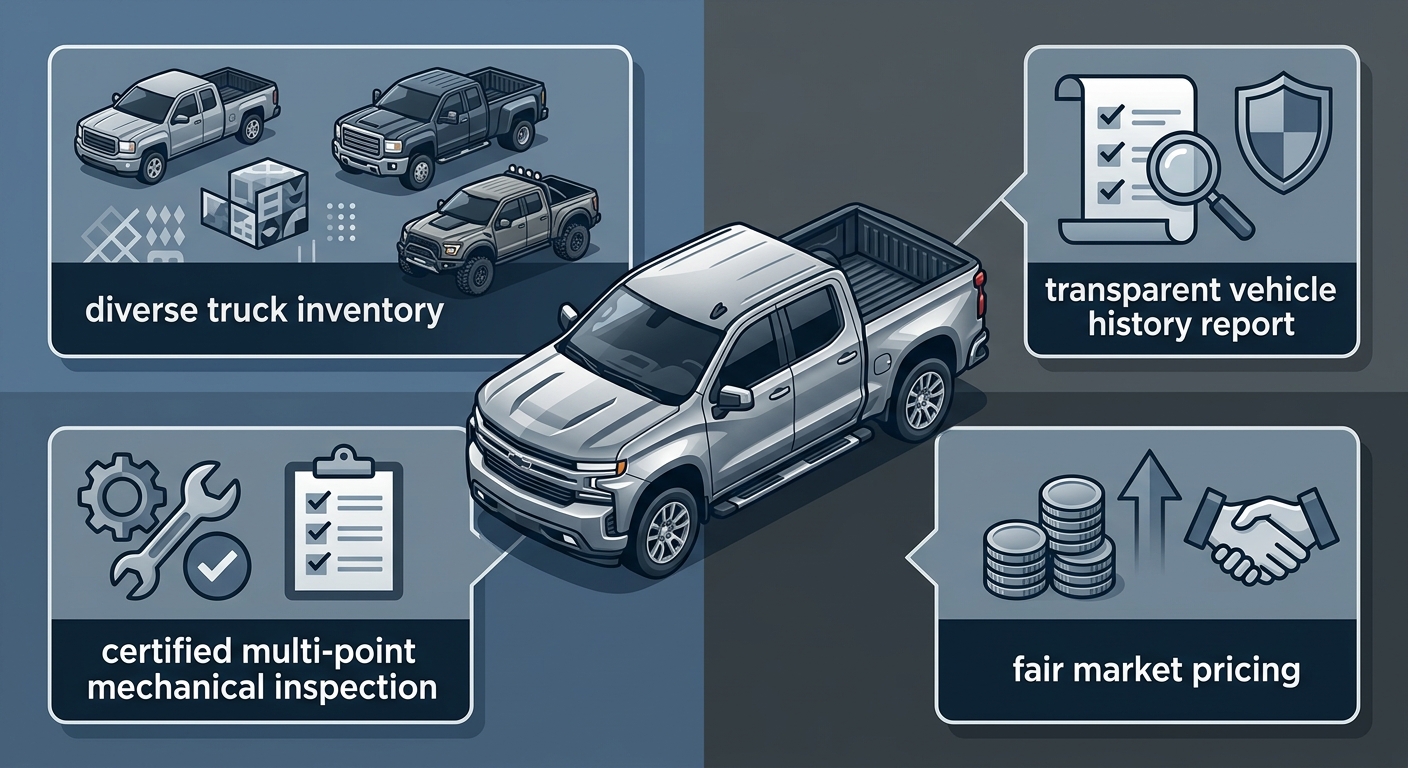
To find the best used truck dealer near Shelbyville, TN, evaluate inventory diversity across half-ton and midsize models, review vehicle history transparency, confirm on-site service department capabilities for pre-purchase inspections, and verify competitive market pricing. Working with a established regional dealership that provides factory-certified multi-point inspections and clear vehicle history documentation ensures you acquire a dependable pickup configured specifically for your towing, payload, and regional driving needs.
Finding the ideal pre-owned truck starts with selecting a dealership that maintains a broad inventory of work-ready trucks and light-duty daily drivers. A reliable dealer should offer full access to vehicle history reports detailing past ownership, service records, and accident history. Transparency in these records eliminates guesswork regarding how a truck was maintained by previous owners. Additionally, top-tier dealerships employ factory-trained technicians who perform rigorous multi-point mechanical inspections on every vehicle before it ever hits the sales lot.
Evaluating the dealership’s physical facility and customer support capabilities is equally critical. Having an integrated service center equipped with specialized hydraulic lifts and advanced diagnostic tools allows the dealership to support your truck long after the sale. Whether you are hauling livestock equipment or pulling a boat down to the Duck River near Christiana, having a local service team available for routine oil changes, transmission maintenance, and brake servicing preserves your truck’s durability and resale value over time.
Establishing clear communication with the sales team simplifies the buying process. A reputable dealership provides competitive trade-in valuations, straightforward pricing without hidden fees, and flexible financing assistance tailored to your budget. You can easily plan your visit by getting our Shelbyville dealership address, or you can speak directly with our staff by giving us a call at (931) 536-3120 to ask about specific models currently in stock.
Table of Contents
- What Are the Most Reliable Used Pickup Trucks to Buy?
- Which Used Trucks Offer the Lowest Maintenance Costs Over Time?
- What Should You Look for in a Used Truck Inspection and High-Mileage Evaluation?
- How Many Miles Is Too Many for a Used Diesel Truck?
- How Do Used Truck Market Prices, Depreciation, and 4WD Upgrades Impact Total Cost?
- Frequently Asked Buyer Questions About Pre-Owned Pickup Trucks
- Taking the Next Step Toward Your Pre-Owned Pickup
What Are the Most Reliable Used Pickup Trucks to Buy?
The most reliable used pickup trucks feature proven engine designs, robust steel or high-strength aluminum frames, and durable automatic transmissions built to handle heavy towing and continuous engine loads. Models like the Chevrolet Silverado 1500 and GMC Sierra 1500 consistently deliver outstanding long-term dependability due to their heavy-duty chassis construction, reliable V8 and turbo-diesel powertrains, and widely available replacement parts.
Full-size trucks equipped with naturally aspirated V8 engines have established long track records for reaching high mileage with basic routine maintenance. For instance, the 5.3L EcoTec3 V8 engine produces 355 hp and 383 lb-ft of torque, delivering dependable pulling power through a durable 6-speed automatic or 10-speed automatic transmission. Buyers seeking maximum fuel efficiency combined with extreme pulling capability often target models featuring the 3.0L Duramax Turbo-Diesel I6 engine, which generates 305 hp and 495 lb-ft of torque while achieving up to 28 MPG on the highway.
For buyers who do not require the footprint of a full-size truck, midsize options present an excellent balance of utility and daily maneuverability. The Chevrolet Colorado offers a sturdy boxed frame and a versatile powertrain lineup capable of handling off-road trails and moderate towing tasks while delivering an EPA-estimated 17 MPG combined rating. When equipped with available driver-assist features like Blind-Spot Monitoring and Rear Cross-Traffic Alert, midsize trucks provide modern highway safety alongside practical bed utility.
When shopping for high-reliability models, reviewing the truck’s underlying maintenance history is just as important as choosing the right engine. Trucks that underwent regular oil changes and transmission fluid services suffer far less mechanical wear over time. If you want to compare late-model pre-owned features against factory-fresh trim options, you can browse our new Chevrolet vehicle inventory to see the latest engineering updates, or reach out to our parts department for advice on original manufacturer replacement components.
Which Used Trucks Offer the Lowest Maintenance Costs Over Time?
Used pickup trucks with naturally aspirated gasoline V8 engines or simple inline-four configurations generally deliver the lowest annual maintenance costs because their mechanical components are widely produced and simple to service. Models utilizing standard overhead-valve V8 engines avoid the complex dual-turbocharger plumbing and high-pressure injection systems found in modern performance engines, keeping average annual routine maintenance expenses lower over long ownership periods.
Routine servicing for popular light-duty trucks centers around predictable consumables such as engine oil, oil filters, engine air filters, and tire rotations. Half-ton trucks engineered with standard suspension setups and solid rear axles feature fewer wearable rubber bushings and electronic dampers than complex independent air suspensions. This traditional chassis layout lowers long-term repair costs when servicing shocks, struts, and ball joints after thousands of miles of rough road driving.
Drivetrain selection also directly influences your long-term service budget:
- Two-wheel drive trucks eliminate the front differential, transfer case, and front CV axles, reducing potential fluid service points and mechanical wear items.
- Four-wheel drive trucks require periodic transfer case fluid changes and front differential flushes every 30,000 to 50,000 miles, adding minor routine maintenance overhead in exchange for superior winter and mud traction.
- Gasoline trucks generally utilize less expensive oil and oil filters during standard maintenance visits compared to heavy-duty diesels that require larger oil capacities and specialized fuel filters.
Keeping maintenance expenses low requires adhering strictly to manufacturer-recommended fluid service schedules. Servicing the transmission fluid, cooling system, and brake fluid at recommended intervals prevents catastrophic component failures that dwarf the cost of routine maintenance. Selecting a popular truck model ensures that local technicians can easily source affordable replacement components whenever repairs become necessary.
What Should You Look for in a Used Truck Inspection and High-Mileage Evaluation?
A thorough pre-owned truck inspection requires evaluating the structural integrity of the frame rails, checking the fluid condition of the transmission and differentials, inspecting the suspension components for excessive play, and examining the bed for evidence of commercial overloading. Conducting a systematic physical examination ensures that a high-mileage pickup remains structurally sound and mechanically reliable before you make a purchase commitment.
Begin your inspection under the vehicle by checking the frame crossmembers and chassis rails for structural rust. Surface discoloration is normal on aged steel, but severe flaking, deep scaling, or rust perforation compromises the vehicle’s safety and towing capacity. Move to the rear of the truck to inspect the factory receiver hitch and trailer wiring harness; excessive rust or bent mounting plates indicate that the vehicle was frequently used to pull heavy loads near its maximum towing threshold.
When buyers evaluate a high-mileage pickup on our lot, they usually check the frame rails for surface scaling and verify the transmission service history before taking the truck out on a road test. Under the hood, check the engine oil dipstick for sludge buildup and pull the transmission fluid dipstick (where accessible) to verify that the fluid is translucent rather than dark or burnt-smelling. Dark, burnt fluid signals thermal breakdown and internal clutch wear inside the transmission.
In the truck bed, inspect the inner wheel wells and floor panels. Deep metal gouges, severe floor waves, or cracked bed liners suggest that previous owners regularly dropped heavy gravel, stone, or industrial equipment into the bed. Finish the physical evaluation by driving the vehicle at highway speeds to check for driveline vibrations, uneven tire wear, steering wheel play, and firm transmission gear shifts under heavy acceleration.
How Many Miles Is Too Many for a Used Diesel Truck?
A well-maintained used diesel truck can comfortably operate beyond 250,000 to 300,000 miles because diesel engines utilize heavy-duty cast-iron engine blocks, forged internal components, and lower engine operational RPMs compared to gasoline engines. However, overall vehicle condition depends heavily on the maintenance history of the fuel injection system, turbocharger, and exhaust emissions equipment rather than the odometer reading alone.
Modern half-ton diesel engines, such as the 3.0L Duramax Turbo-Diesel I6, are engineered for exceptional thermal efficiency and long service life. Delivering 305 hp and 495 lb-ft of torque, these engines operate effortlessly under load. However, buyers looking at diesel trucks with over 150,000 miles must review service records for key system components:
- High-pressure fuel pumps and precision fuel injectors require clean, moisture-free diesel fuel; neglected fuel filters can cause expensive fuel system contamination.
- Turbochargers rely on clean engine oil for shaft lubrication; irregular oil changes lead to coked oil bearings and premature turbo seal failure.
- Diesel Particulate Filters (DPF) and Selective Catalytic Reduction (SCR) systems accumulate soot over time and require periodic regeneration or replacement if driven exclusively on short trips.
When evaluating a high-mileage diesel, look for prompt cold-engine starting, clean exhaust output without excessive black or white smoke, and smooth idle performance. A diesel truck with 180,000 miles accompanied by complete maintenance records is often a safer investment than a 100,000-mile diesel truck with missing service histories and evidence of heavy commercial overuse.
How Do Used Truck Market Prices, Depreciation, and 4WD Upgrades Impact Total Cost?
Used truck market pricing is driven by vehicle age, mileage, overall body condition, cab configuration, and powertrain options. Light-duty pickups experience their sharpest valuation drop during their first three years of service, after which annual depreciation stabilizes to roughly 10% to 15% per year, making three- to six-year-old pre-owned trucks exceptionally strong value propositions for savvy buyers.
Selecting a four-wheel drive drivetrain typically adds between $3,000 and $5,000 to the purchase price of a pre-owned truck compared to an equivalent two-wheel drive model. In regional markets with varied terrain, four-wheel drive retains a significant portion of its original value at resale time. For drivers navigating rural farm roads or wet secondary highways around Lewisburg, the added traction and higher resale retention make the initial investment in four-wheel drive worthwhile.
Trims and factory equipment packages also influence long-term valuation curves:
- Standard work truck trim levels offer the lowest entry price and minimal electrical complexity, making them cost-effective utility vehicles.
- Mid-level crew cab trims equipped with towing packages, integrated trailer brake controllers, and luxury interior amenities hold their value firmly due to high demand among family-truck buyers.
- Specialized off-road packages and heavy-duty towing options retain strong market interest, though aftermarket suspension lifts often reduce resale value if installed incorrectly.
Calculating total ownership cost requires factoring in auto insurance premiums, state vehicle registration fees, fuel consumption, and planned maintenance alongside your initial purchase price. Choosing a pre-owned truck that has already absorbed its initial steep depreciation window protects your equity while delivering full towing and hauling utility.
Frequently Asked Buyer Questions About Pre-Owned Pickup Trucks
Q: What paperwork should I bring when buying a pre-owned truck?
Bring a valid driver’s license, current proof of auto insurance, your most recent pay stubs or proof of income, and title documentation if you plan to trade in your current vehicle. Having these documents organized accelerates the transaction process and helps our finance team secure competitive loan terms. You can streamline the timeline even further by prequalifying for auto financing online before arriving at the dealership.
Q: How can I tell if a used truck was used for heavy towing?
Look for telltale physical signs such as heavy wear inside the trailer receiver hitch tube, severe scratching around the trailer wiring plug, an aftermarket gooseneck or fifth-wheel hitch footprint in the bed, and dark transmission fluid. Additionally, examine the rear leaf springs or coil suspension for flattening, which indicates prolonged heavy tongue weight or severe payload stress.
Q: Is a certified pre-owned truck worth the extra investment?
Yes, certified pre-owned vehicles undergo rigorous multi-point safety and mechanical inspections by factory-trained technicians before earning certification. They typically include extended powertrain warranty coverage, detailed vehicle history verification, and emergency roadside assistance benefits, providing superior peace of mind compared to uninspected private-party purchases. You can review current inventory options by exploring our pre-owned vehicle specials.
Q: What is the maximum towing capacity available on a pre-owned half-ton truck?
When properly configured with a specialized trailering package and either a 6.2L EcoTec3 V8 or 3.0L Duramax Turbo-Diesel I6 engine, select light-duty trucks like the Chevrolet Silverado 1500 can achieve a maximum towing capacity of up to 13,300 pounds. Always check the specific tire and loading information decal located on the driver-side door jamb to confirm the exact payload and gross combined weight ratings for an individual vehicle.
Q: How often should the brakes be inspected on a used pickup truck?
Brake pads and rotors should be inspected during every routine oil change, or at minimum every 7,500 to 10,000 miles. Trucks frequently used for towing heavy trailers or driving through hilly terrain experience accelerated brake wear and require more frequent pad replacements and fluid checks. If you notice pedal pulsing or squeal during braking, consider scheduling a brake inspection with a qualified technician promptly.
Taking the Next Step Toward Your Pre-Owned Pickup
Selecting the ideal pre-owned pickup requires balancing engine capability, frame condition, drivetrain options, and long-term maintenance expectations against your real-world work and recreation demands. By systematically inspecting frame integrity, checking fluid quality, reviewing vehicle history reports, and testing four-wheel drive operation, you can buy a dependable truck with total confidence.
Our team at Newton Chevrolet GMC is ready to help you compare engine choices, evaluate cab configurations, and test-drive work-ready trucks on our lot. Whether you need a half-ton crew cab for weekend highway trips or a high-torque turbo-diesel for daily trailering, our transparent appraisal process and reconditioned inventory ensure you find the right fit for your budget.
Visit our showroom today to explore our pre-owned lineup in person. You can get exact directions to our Shelbyville showroom to inspect our latest trade-in arrivals, or call our team directly at (931) 536-3120 to schedule a test drive and get expert answers to all your pre-owned truck questions.
0 comment(s) so far on How Can I Find the Best Used Truck Dealer Near Me?