



What Towing Capacity Can a 2025 Chevrolet Silverado HD Provide for a Horse Trailer?
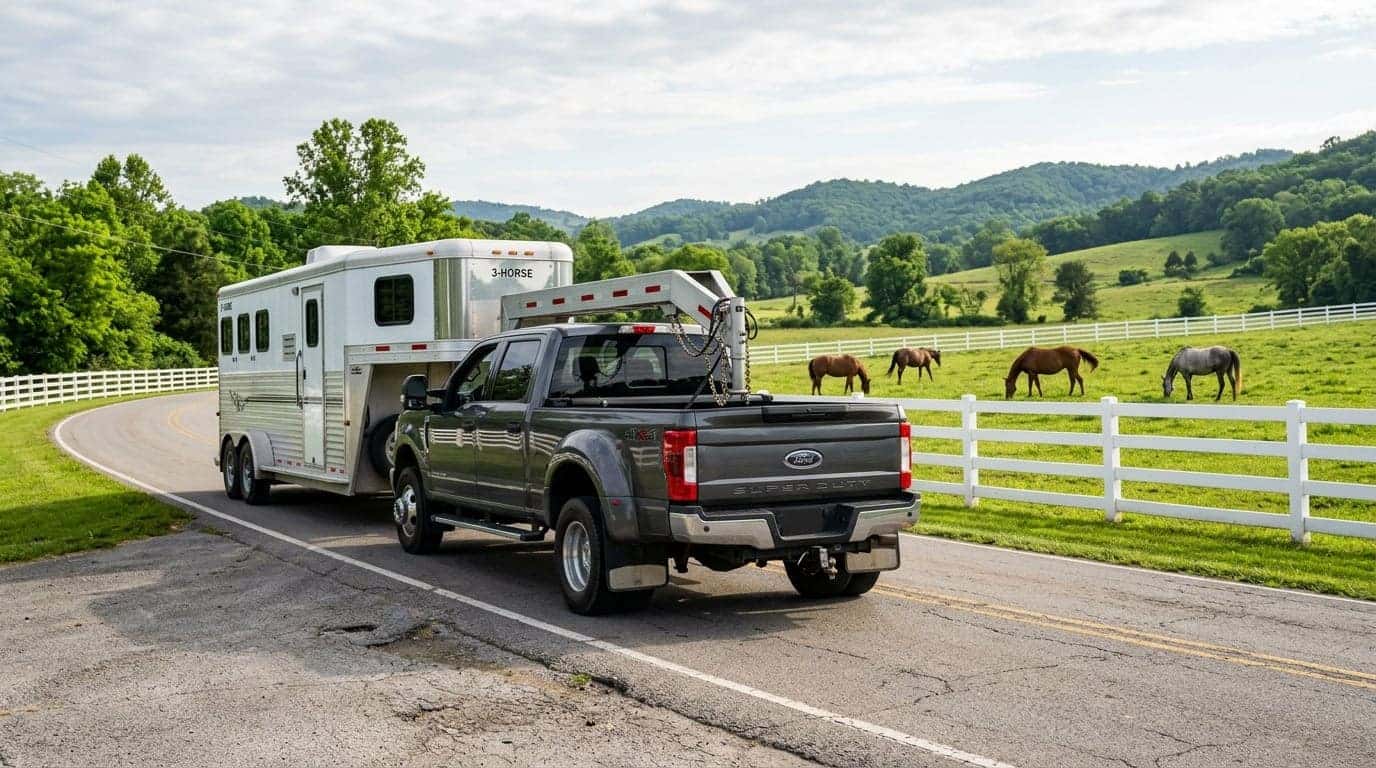
A properly equipped 2025 Chevrolet Silverado 2500 HD provides up to 22,500 pounds of maximum gooseneck towing capacity and 20,000 pounds of conventional towing capacity, while a 3500 HD model pulls up to 36,000 pounds. For a standard two-to-four-horse aluminum trailer with living quarters, a 2500 HD effortlessly handles both livestock weight and trailer tongue requirements.
Transporting horses presents distinct trailering challenges due to live cargo weight shifts and high center-of-gravity loads. When evaluating a heavy-duty pickup for equestrian needs, overall tow capacity is only the starting point. Drivers must factor in the weight of horses (averaging 1,000 to 1,200 pounds each), tack, filled water tanks, and feed alongside the dry weight of the trailer itself.
A 2500 HD model easily manages typical bumper-pull and light gooseneck trailers. However, larger multi-horse goosenecks with luxury living quarters push hitch tongue weights higher, making gross vehicle weight ratings and payload capacity critical considerations. Exploring our new Chevrolet Silverado HD inventory reveals models pre-configured with factory trailering packages to handle these exact demands. You can check vehicle specs in person by visiting our Shelbyville showroom or (931) 536-3120 for specific chassis ratings.
Table of Contents
- What Engine Options Are Available in Chevy Silverado HD and GMC Sierra HD Trucks?
- What Is the Difference in Payload and Towing Capacity Between 2500 HD and 3500 HD Models?
- How Does Gooseneck Towing Compare to Conventional Hitching for Horse Trailers in Christiana?
- Does GMC Offer Unique Tailgate and Trailering Tech Features for Loading Horse Gear?
- How Does Empty Ride Comfort Compare Between a 2500 HD and 3500 HD?
- What Should Horse Owners Verify Before Purchasing a Heavy-Duty Truck?
- Essential Trailering Questions Before Choosing a Heavy-Duty Truck
- Find Your Next Heavy-Duty Horse Towing Truck at Newton Chevrolet GMC
What Engine Options Are Available in Chevy Silverado HD and GMC Sierra HD Trucks?
Heavy-duty Chevy Silverado HD and GMC Sierra HD trucks offer two engine options: a standard 6.6-liter gasoline V8 producing 401 horsepower and 464 lb-ft of torque, and an available 6.6-liter Duramax Turbo-Diesel V8 generating 470 horsepower and 975 lb-ft of torque. Both engines pair directly with an Allison 10-speed automatic transmission for seamless gear progression.
Choosing between gasoline and diesel powertrains comes down to hauling frequency, trailer weight, and highway terrain. The standard 6.6-liter gas engine provides quick throttle response and robust power for regional towing and lighter two-horse trailers. Because it uses direct injection and variable valve timing, it delivers predictable power up steep grades without requiring diesel exhaust fluid maintenance.
For frequent long-distance trailering or pulling heavy gooseneck configurations, the 6.6-liter Duramax turbo-diesel V8 offers unmatched pulling power. Its 975 lb-ft of torque reaches full output at just 1,600 rpm, allowing the truck to maintain cruising speed with low engine stress when hauling multi-horse trailers. The diesel powertrain also incorporates an integrated exhaust brake, which utilizes variable turbocharger geometry to slow the truck on downhill downgrades and reduce wear on service brakes. Reviewing detailed GMC Sierra HD research helps buyers match engine output to their specific trailering demands, and our team can walk you through online financing options to help structure your truck purchase.
What Is the Difference in Payload and Towing Capacity Between 2500 HD and 3500 HD Models?
Single-rear-wheel 3500 HD models provide roughly 500 to 1,000 pounds more payload capacity than equivalent 2500 HD trucks due to stiffer rear leaf spring assemblies. While a 2500 HD tops out at a maximum payload of 3,850 pounds, a 3500 HD reaches up to 7,234 pounds in dual-rear-wheel configurations.
Payload rating dictates how much weight a truck can support inside the bed and cabin, including passenger weight, cargo, tack, and trailer pin or tongue weight. Gooseneck and fifth-wheel horse trailers transfer roughly 20 to 25 percent of their total loaded weight directly onto the truck’s rear axle inside the bed. A loaded 12,000-pound gooseneck horse trailer can exert 2,500 pounds of downward pin weight, which quickly consumes a 2500 HD truck’s available payload once passengers and gear are onboard.
Upgrading to a 3500 HD single-rear-wheel or dual-rear-wheel chassis expands payload head-room without dramatically altering vehicle footprint. Dual-rear-wheel 3500 HD models also offer enhanced lateral stability against crosswinds and shifting livestock. Browsing our new GMC Sierra HD selection allows equestrian haulers to compare gross vehicle weight rating labels across configurations. If you require specialized fifth-wheel or gooseneck hitch hardware installed prior to pickup, our parts department team stocks genuine factory towing accessories designed for heavy-duty frames.
How Does Gooseneck Towing Compare to Conventional Hitching for Horse Trailers in Christiana?
Gooseneck hitches anchor directly over the truck’s rear axle inside the bed, delivering superior weight distribution, higher weight capacities, and tighter turning angles compared to bumper-mounted conventional receivers. On the gently rolling farmland and narrow farmyard access routes around Christiana, gooseneck hitches dramatically reduce sway from moving horses and make sharp turns around barns far easier.
Conventional hitching relies on a receiver ball mounted below the rear bumper. This leverage point sits several feet behind the rear axle, creating a fulcrum effect that can cause rear-end squat and steering light-headedness when carrying heavy tongue loads. Additionally, abrupt movements by horses inside a bumper-pull trailer exert side-to-side force behind the rear tires, amplifying trailer sway at highway speeds.
Gooseneck hitches eliminate that leverage point by placing the connection point directly above the rear differential. Downward pin weight presses straight into the truck’s frame and rear axle, preserving front-tire traction and steering control. Gooseneck trailers also permit up to 90-degree turning angles, allowing drivers to pivot large trailers in tight staging areas without binding. Exploring our GMC competitor comparison guide demonstrates how integrated factory bed prep packages streamline gooseneck installation right from the assembly line.
Does GMC Offer Unique Tailgate and Trailering Tech Features for Loading Horse Gear?
GMC Sierra HD models feature an available 6-function MultiPro Tailgate that converts into a fold-down step, entry platform, and work bench to make loading heavy saddles and gear effortless. Complemented by an available camera system offering up to 14 views, including Transparent Trailer View, GMC heavy-duty trucks provide specialized operational tech for horse haulers.
Loading heavy equestrian gear like western saddles, water jugs, and hay bales into a tall truck bed can cause physical strain. The MultiPro Tailgate solves this with a primary gate inner panel that folds down into a wide step supporting up to 375 pounds. The inner gate can also drop down independently, allowing drivers to stand closer to the bed floor for easier access when unloading equipment.
Beyond tailgate ergonomics, trailering technology enhances visibility and peace of mind when carrying live animals. The available camera system includes a bed-view camera to monitor gooseneck hitch connections and check on livestock in open stock trailers. The innovative Transparent Trailer View utilizes a tailgate-mounted camera and an auxiliary rear-trailer camera to create a composite image on the center touchscreen, effectively allowing drivers to see right through an attached trailer to monitor trailing traffic. Trailer Side Blind Zone Alert and an integrated trailer brake controller complete the tech package by extending blind-spot monitoring along the full length of the trailer.
How Does Empty Ride Comfort Compare Between a 2500 HD and 3500 HD?
Unladen 2500 HD trucks deliver a softer, more compliant ride over rough pavement because their rear leaf spring suspension uses lower spring rates than stiffer 3500 HD configurations. Without a heavy horse trailer attached, a 3500 HD exhibits a firmer rear bounce designed strictly to handle high payload and pin weights.
Heavy-duty truck suspensions are engineered to balance load capacity against chassis stability. In 2500 HD models, engineers tune the rear leaf springs to provide comfortable damping during daily commutes while still offering robust support when loaded. This creates a balanced ride quality for drivers who use their vehicle for everyday transportation between towing weekend horse events.
Our advisors see that horse owners who use their truck as a daily driver between weekend shows usually compare the unladen ride of the 2500 HD against the 3500 HD first before committing to a suspension tier. In contrast, 3500 HD models incorporate additional overload leaf springs and firmer shocks designed to remain stationary until several thousand pounds press down on the rear axle. When driving a 3500 HD empty, road irregularities transmit more directly into the cabin. However, once a heavy gooseneck trailer settles onto the hitch ball, the 3500 HD suspension compresses into its optimal operating range, delivering exceptional stability and smooth highway tracking.
What Should Horse Owners Verify Before Purchasing a Heavy-Duty Truck?
Buyers must check the truck’s VIN-specific trailering information label on the driver-side door pillar, which lists exact maximum conventional, gooseneck, payload, and gross axle weight ratings for that specific vehicle build. Before hauling horses along the agricultural routes around Lewisburg, verifying these specs against trailer gross vehicle weight ratings ensures safe and legal operation.
Factory trailering charts list maximum possible figures for optimal builds, but individual truck options—such as crew cabs, four-wheel-drive transfer cases, skid plates, and luxury interior packages—add weight that reduces net payload. Examining the door jamb certification label reveals the true remaining payload capacity for tongue weight, passengers, and tack.
Beyond payload labels, buyers should confirm key mechanical equipment. A factory-installed gooseneck or fifth-wheel prep package provides integrated frame crossmembers and bed pucks, avoiding costly aftermarket frame drilling. An integrated trailer brake controller ensures precise electric-over-hydraulic trailer brake modulation linked directly to the truck’s antilock braking system. Finally, verify that the truck includes heavy-duty engine oil and transmission fluid cooling systems, high-output alternators, and extendable trailering mirrors. You can inspect trailer-ready trucks in person at our dealer location on Main Street or start by giving our team a call today.
Essential Trailering Questions Before Choosing a Heavy-Duty Truck
Q: Do I need a dually 3500 HD truck to tow a two-horse gooseneck trailer?
A single-rear-wheel 2500 HD or 3500 HD truck easily manages a two-horse gooseneck trailer. Two-horse goosenecks typically weigh between 5,000 and 8,000 pounds loaded, producing a pin weight of around 1,000 to 1,600 pounds. This falls well within the payload and towing limits of a single-rear-wheel 2500 HD chassis. Dual-rear-wheel models become necessary primarily when towing four-or-more-horse gooseneck trailers with heavy living quarters.
Q: How does the integrated trailer brake controller function on heavy-duty GM trucks?
The integrated trailer brake controller communicates directly with the truck’s antilock braking and electronic stability control systems to deliver proportional braking force to the trailer. Drivers can adjust gain settings on the dash to match trailer weight. The system also includes Auto Grade Braking, which automatically downshifts the 10-speed transmission on downhill slopes to maintain speed without riding the service brakes.
Q: What is the benefit of Tow/Haul mode when transporting live animals?
Tow/Haul mode alters transmission shift points to reduce gear hunting and keep the engine in its power band during acceleration and braking. For horse hauling, this smooths out acceleration and deceleration forces, preventing sudden momentum shifts that can startle livestock inside the trailer. It also activates engine braking features to assist in controlled downhill descents.
Q: Is the standard 6.6-liter gas engine sufficient for pulling horse trailers in hilly terrain?
The 6.6-liter gas engine delivers 401 horsepower and 464 lb-ft of torque, providing plenty of power for pulling trailers up to 14,000 pounds through rolling hills. Paired with the Allison 10-speed transmission, it maintains steady momentum by staying in optimal gear ratios. However, drivers who frequently tow multi-horse goosenecks over 15,000 pounds through steep mountain passes will prefer the 975 lb-ft of torque provided by the Duramax diesel.
Q: Can I add a gooseneck hitch to a truck that did not come with the factory prep package?
High-quality aftermarket gooseneck hitches can be installed under the bed floor on heavy-duty trucks without the factory prep package. However, choosing a truck with the factory-installed gooseneck prep package ensures structural crossmembers are integrated directly into the boxed frame rails at the assembly line, complete with flush-mounted bed pucks and a 7-pin electrical connector inside the bed wall.
Find Your Next Heavy-Duty Horse Towing Truck at Newton Chevrolet GMC
Selecting the ideal heavy-duty truck for horse trailering requires balancing engine performance, payload limits, hitch configuration, and daily driving comfort. Whether you prefer the versatile Silverado 2500 HD or the max-capacity Sierra 3500 HD, matching your trailer’s loaded pin weight and gross vehicle ratings to the truck ensures years of confident livestock transport.
Our team is ready to walk you through door jamb specs, test-drive gas and diesel powertrains, and demonstrate advanced trailering camera technology. Visit us on Main Street or contact our team online to discover the right heavy-duty truck for your horse hauling needs.
0 comment(s) so far on What Towing Capacity Can a 2025 Chevrolet Silverado HD Provide for a Horse Trailer?